Saturday, October 1, 2011

Michael Mann analysis - part 2: Manipulating one's own state of mind

CATEGORY: MOVIES

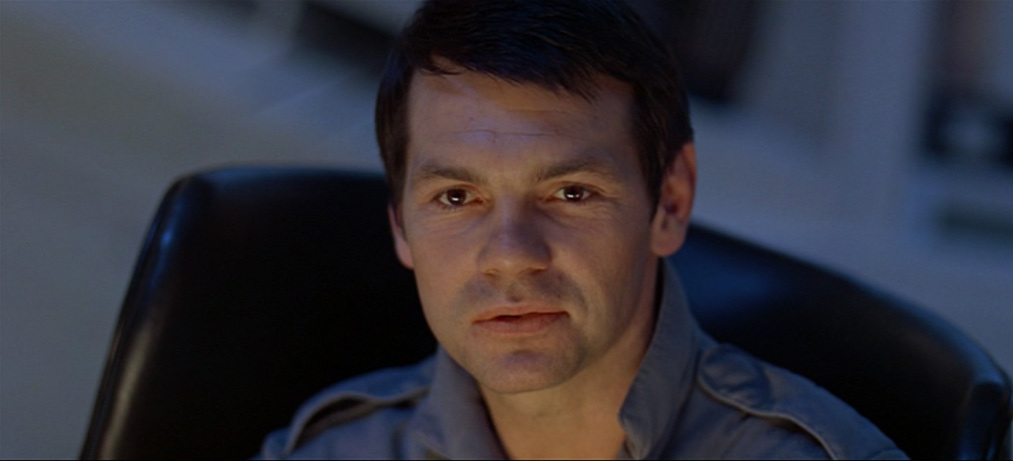
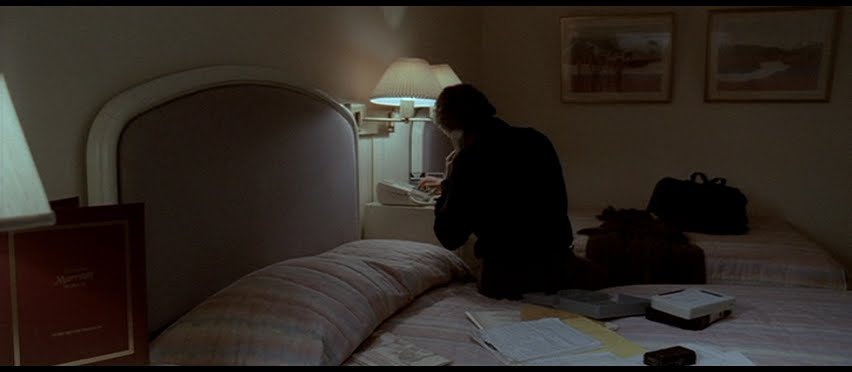
From Manhunter: FBI investigator Will Graham calls his wife, Molly, from his hotel room in Atlanta. To 'set himself up' for getting inside a killer's head (in this case, that of the 'Tooth Fairy'), Graham uses the people in his environment to manipulate his own state of mind. This is effectively what he's doing in this brief conversation with Molly. Immediately after the call, he enters the killer's mind while viewing the victims' home movies, and he then has an important insight which may help solve the killings. The basic idea is that Graham's using Molly to get himself 'wound up', so that he can be productive at his job.


From Collateral: Annie Farrell, an attorney, describes her courtroom routine to cab driver Max Durocher: "I represent the Department of Justice, and my opening statement is gonna fall flat at the most important point, and the jury's gonna laugh at me. And then I cry. I don't throw up. A lot of people throw up, I have a strong stomach. And then I pull myself together, I rewrite my opening statement, work my exhibits, and that's what I do for the rest of the night. That's my routine. And in the morning when [the trial] starts, I'm fine."


Will Graham and Annie Farrell are doing something we all do, whether we realize it or not: Each of us periodically uses his or her own situation or surroundings to 'spin himself/herself up', thus creating an internal emotional tension which provides a form of energy within our psyches; one which is necessary to lead a productive life. Without periodically invoking this tension, we would grow complacent, and would become less active.


Monday, September 26, 2011

Hannibal Rising analysis - part 9: Young Hannibal represents a golem

CATEGORY: MOVIES

Reproduction of the Prague Golem. [Image from the Wikipedia 'Golem' page, public domain, via Wikimedia Commons.]


In Jewish folklore, a golem is an animated anthropomorphic being, created entirely from inanimate matter. The word was used to mean an amorphous, unformed material in Psalms and medieval writing. The most famous golem narrative involves Judah Loew ben Bezalel, the late-16th-century rabbi of Prague. There are many tales differing on how the golem was brought to life and afterwards controlled.


The earliest stories of golems date to early Judaism. Early on, the main disability of the golem was its inability to speak.[a] Recall that Hannibal is essentially mute for a period of time, i.e., in the orphanage (above left), up until he has been with Lady Murasaki for a while (above right).


Part of the golem legend sometimes depicts the golem as eventually becoming evil, turning on society. By the end of Hannibal Rising, Hannibal has obviously become evil. In the Lecter movies that are set later than Hannibal Rising (The Silence of the Lambs, etc.) it becomes evident that Lecter, as a full adult, has turned on society, symbolizing the fact that this is what the evil hermaphroditic Jews have done.


a. Wikipedia, 'Golem'. Web, n.d. URL = https://en.wikipedia.org/wiki/Golem.


Saturday, September 24, 2011

2001 analysis - part 10: Another correspondence with 'Pulp Fiction'

CATEGORY: MOVIES


From Pulp Fiction: Boxer Butch Coolidge places a phone call.


The above screencap from Pulp Fiction depicts boxer Butch Coolidge making a call to find out when he can collect on some gambling winnings. The background to this is that Butch had promised gang boss Marsellus Wallace that he would throw a fight (i.e., lose on purpose), but he then proceeded to win the fight instead, killing his opponent, Floyd Wilson, who was favored to win. Prior to the fight, he gambled all his money on himself to win, and now is in a position to collect a large payoff. After the fight, he flees the arena, then calls a man named Scotty from a payphone, to find out how much he has won and when he can collect. During the phone conversation, movie-goers hear only Butch's part of the dialogue. First we'll look at the conversation itself, then we'll see how it refers to things having to do with A Space Odyssey.

Butch (into phone): "What the fuck I tell ya, hah? As soon as the word got out the fix was in man, the odds went through the roof. I know, I know. Unbelievable. Hey, fuck 'im Scotty, if he was a better boxer, he'd still be alive. If he never laced up his gloves, which he never shoulda done in the first fuckin' place, he'd still be alive. Yeah, well, who gives a fuck, it's over now. Yeah, well, enough about the poor, unfortunate Mr. Floyd - let's talk about the rich and prosperous Mr. Butch. How many bookies you lay it around on?"

(pause)

"All eight? How long to collect?"

(pause)

"So you'll have it all by tomorrow night?"

(pause)

"No, I understand, a few stragglers aside. Ah, fuck, Scotty, that is good news, that is great news, man. Yeah. Mm-mm. No, me an' Fabienne are gonna leave in the morning. It'll probably take us a couple o' days to get down to Knoxville. Okay, my brother. (Laughs.) You're right, you're goddamn right. Alright, Scotty, next time I see you, it'll be on Tennessee time. Cool, brother."

Butch hangs up.

---------------------

Though "Mr. Floyd" ostensibly refers to the now deceased boxing opponent whom Butch defeated, Floyd Wilson, it is also to be taken as a reference to Heywood Floyd from 2001. "Scotty" is a reference to the Montgomery "Scotty" Scott character from the original Star Trek TV series. What's being suggested is that Butch is talking with someone who is, in some sense, 'in outer space'. "Tennessee time" is a reference to 'Jupiter time' from A Space Odyssey, i.e., it is a reference to 2001's Jupiter mission.


Wednesday, September 21, 2011

2001 analysis - part 9: More on the relationship with 'Reservoir Dogs'

CATEGORY: MOVIES

Recall from the introduction to this analysis, that at one point while Heywood Floyd and five other astronauts are near the monolith at TMA-1 (on the moon), it starts making a high-pitched noise. In an interview that took place not long after A Space Odyssey was released, Kubrick referred to this noise as a "kind of cosmic burglar alarm."[a]


In this screencap, some of the six men at TMA-1 are shown raising their hands as if to cover their ears, in response to the monolith's loud, high-pitched noise.


Also stated earlier in the analysis (in part 4) was that the six men with colors for their names in Quentin Tarantino's Reservoir Dogs, correspond, within some context, to the six astronauts at TMA-1 in A Space Odyssey. As it turns out, the basic underlying correspondence between the two films is that they both involve a diamond heist.

In Reservoir Dogs, the six gangsters (Mr. Blonde, Mr. Brown, Mr. White, Mr. Orange, Mr. Pink, and Mr. Blue) rob a bank of some diamonds, but the film's audience is never shown the actual robbery, only certain events that occur before and after it. This corresponds to the heist in A Space Odyssey: We are never shown the heist itself, but the fact is that the monolith on the moon (at TMA-1) contains stolen diamonds, and the events that occur among the six men there take place after the heist: Immediately subsequent to the monolith sounding its 'burglar alarm' (which corresponds to the bank alarm that goes off during the robbery in Reservoir Dogs),[b] there is some kind of 'face-off' among the six men at TMA-1, i.e., there is chaos and fighting among them, with some of them being killed (by having their air hoses disconnected). The correspondence for this in Reservoir Dogs, is the chaos and fighting involving its six robbers (along with other people), with some of them being killed. However, in 2001, we are not only not shown the heist, but we are not shown the face-off either.

The importance of diamonds and their being stolen in A Space Odyssey, and of certain events being 'hidden' from the 2001 audience, will be gone into in more detail later in this analysis. What's important to realize here is that in showing us what takes place after the heist in Reservoir Dogs, Tarantino is giving us hints about what actually occurs in A Space Odyssey, i.e., some of the events in Reservoir Dogs are, in part, representations of some of the events in 2001 which we don't see.


In Reservoir Dogs, an injured Mr. Orange is held by Mr. White, in a warehouse the two men have escaped to after the bank robbery.


a. Gelmis, Joseph. The Film Director as Superstar. Doubleday, 1970. p. 304.
b. Since the heist in Reservoir Dogs is not shown, the film's audience doesn't actually hear an alarm go off. However, it becomes evident that such an alarm did sound, as revealed when this alarm is mentioned after the robbery, during a conversation between Mr. Pink and Mr. White.


Friday, September 16, 2011

2001 analysis - part 8: Other references from 'Pulp Fiction'

CATEGORY: MOVIES


The dance floor at restaurant and club Jack Rabbit Slim's in Pulp Fiction (above left), has a design painted on it that is reminiscent of HAL's eye (above right).


The 'imaginary' rectangle Mia has drawn during her conversation with Vincent in Pulp Fiction (above left), reminds us of the lighted border surrounding the lunar lander landing pad in 2001 (above right).


In Pulp Fiction, Mia's home security system control center, with its lights, panels, and monitors (above left), is reminiscent of the various cockpit panels shown in A Space Odyssey (e.g., those of the Pan Am space plane shown at above right).


The emergency adrenaline injection revival kit in Pulp Fiction (above left), is a reference to the emergency revival control modules attached to each of the hibernating astronauts' pods in 2001 (above right).


Thursday, September 15, 2011

Table of Contents to the 2001: A Space Odyssey analysis

CATEGORY: MOVIES; WARNING: THIS ANALYSIS CONTAINS SPOILERS!!


There is a button that links to this table of contents, at the bottom of each post in the analysis.

part 1 - Introduction and plot synopsis

part 2 - The HAL computer as Shakespearean

part 3 - Dave Bowman's experience at the end of the movie, encapsulates the movie's enlightenment-death-rebirth theme

part 4 - The six men with colors for their names in Quentin Tarantino's movie, Reservoir Dogs, represent the six astronauts at TMA-1

part 5 - Hints from Tarantino's Pulp Fiction

part 6 - Representation of gold; rel. to Pulp Fiction

part 7 - More correspondences with Pulp Fiction: The bar scene in Pulp Fiction is related to the 2001 lunar lander. Reference to a sphinx is being made

part 8 - More visual references from Pulp Fiction

part 9 - More on the relationship between A Space Odyssey and Quentin Tarantino's Reservoir Dogs

part 10 - Another correspondence with Pulp Fiction : Butch Coolidge mentions "the poor, unfortunate Mr. Floyd"

part 11 - The hidden plot: Heywood Floyd is an alien

part 12 - The 'Dawn of Man' is set in Mexico, not Africa

part 13 - Bowman suffers a brain injury when he is 'ejected' from his EVA pod into the emergency airlock of Discovery One

part 14 - Hints from David Lynch; color symbolism; women in space as 'prostitutes'

part 15 - Tarantino: Depiction of the alchemical nigredo - each appearance of the monolith is accompanied by a nigredo

part 16 - Hints from the films of Michael Mann: a reference to the Dawn of Man being set in Mexico

part 17 - More from Mann: Bowman goes into a trance while watching Heywood Floyd on the video monitor

part 18 - Tarantino: Poole and Bowman represent yin and yang; Bowman fails to save the feminine

part 19 - The hidden plot (cont'd): The relationship between Bowman and Floyd (Bowman assumes Floyd's 'alien identity')

part 20 - Tarantino and Lynch: A Space Odyssey has a circular narrative

part 21 - Mann: Bowman moves through the circles of Hell

part 22 - The symbolism of the diamonds in the stargate, and of the Discovery One spaceship

part 23 - Lynch: A Space Odyssey contains a 'movie within a movie'

part 24 - Bowman experiences the beatific vision while in the stargate

part 25 - The physical meaning of the stargate

part 26 - More on Bowman's brain injury: In addition to suffering a subdural hematoma, Bowman also suffers a subarachnoid hemorrhage

part 27 - The hidden plot (cont'd): The events at TMA-1

part 28 - More hints from Mulholland Drive

part 29 - The relationship of A Space Odyssey to the Hannibal Lecter movies; the entities that HAL represents

part 30 - Mann: The 'Jonah and the whale' allegory

part 31 - HAL is like a golem; this links him to Hannibal Lecter

part 32 - Kubrick's statement about the Jews and Nazis

part 33 - Tarantino: Bowman's (drug) 'trip' through the stargate

part 34 - Tarantino, Mann, and Lynch: Allusions to Kubrick's philosophy of periodically making light of serious situations in his films

part 35 - The meeting at Clavius; the monolith's shape: the reason it is rectangular instead of square

part 36 - More on alchemy in the movie; Kubrick is depicting an unsuccessful citrinitas, and thus, an incomplete alchemical process

part 37 - 'Faked' aspects of the Jupiter mission film: There are hints in the movie that part of the Jupiter mission film (the 'movie within a movie'), is being recorded on the space station instead of on Discovery One

part 38 - By designing A Space Odyssey as an allegory for both Homer's The Odyssey, and Jonah and the whale, Kubrick was trying to draw attention to the fact that both of these tales have a common underlying source: The Epic of Gilgamesh.

part 39 - Water symbolism

part 40 - Mann: Death of the Holy Spirit

part 41 - The alien wants to unite with Bowman, in order to become Mercurius

part 42 - Tarantino: Kubrick on casual acceptance of violence

part 43 - The aliens are 'stealing' diamonds from Earth

part 44 - Hints from The Silence of the Lambs

part 45 - Numerical clues in the movie; the '5 + 3' ogdoadal system

part 46 - Lynch: The unconscious confronts the intellect

part 47 - St. Augustine versus the Manichaeans

part 48 - Kubrick's 'child abuse' theme: HAL is like someone who has been abused as a child

part 49 - Elements of Hindu philosophy in 2001; more on the manipulation of Bowman's psyche

part 50 - Certain parts of the movie depict dreams

part 51 - We link Bowman's assimilation of his own shadow, to his experience as Jonah in the whale

part 52 - Mann: Depiction of the tension between containment and liberation

part 53 - More information on Melusina, the feminine aspect of Mercurius. The alien who 'combines' with Bowman represents Melusina

part 54 - More on the correspondence with Pulp Fiction

part 55 - The aliens represent the 'evil feminine' (e.g., radical feminists)

part 56 - The partially-faked mission film's intended audience is Generation Y; Kubrick was predicting that this generation, and all subsequent generations, would be 'brainwashed' by radical feminists working in concert with powerful men in the entertainment industry and news media

part 57 - Kubrick gives us a warning: Defy misdirection, such as that given by persons in power, certain parties in the entertainment industry and news media, and certain special interest groups

part 58 - Hints in the movie poster

part 59 - The conception allegory; the unconscious as a 'womb'. At least part of the movie is taking place 'inside' Bowman's unconscious

part 60 - Reference to the game of billiards is being made in the movie

part 61 - Kubrick is employing the billiards reference to make a point about the effect of one's attitude in life on the course of one's life, and about the relationship of this to randomness in the universe

part 62 - The fact that the monolith contains diamonds, is linked to the Pulp Fiction briefcase contents

part 63 - The movie contains a numerical reference to the biblical book of Proverbs

part 64 - Clarification on the meaning of the end sequence

part 65 - Fundamentals of chakras; application of concepts from Vishuddha (throat) chakra to the movie

part 66 - The correspondence of 2001 with Joseph Campbell's monomyth

part 67 - Kubrick believed that all civilizations have a common source

part 68 - The reason the aliens need diamonds; final observations
Saturday, September 3, 2011

2001 analysis - part 7: More correspondences with 'Pulp Fiction'

CATEGORY: MOVIES


Top left: In A Space Odyssey, the pilot and co-pilot of the lunar lander are served food (by a stewardess) in the lander cockpit. Top right: A view of the interior of Marsellus Wallace's restaurant/bar from Pulp Fiction. Note that the red coloring used in this scene, is similar to the red of the 2001 lunar lander cockpit interior. Above left: The 2001 lunar lander on its landing pad. The shape and surface features of the lander make it appear somewhat similar to a sphinx's head and face, with the two windows representing eyes (click image to enlarge). Above right: The head of the Great Sphinx of Giza, ca. 1870's. [Image from the Wikipedia 'Great Sphinx of Giza' page, public domain, via Wikimedia Commons.]


In Pulp Fiction, boxer Butch Coolidge maintains a 'sphinx-like' silence and facial appearance, while being ordered by Marsellus Wallace to throw his next boxing match.


Monday, August 29, 2011

2001 analysis - part 6: Representation of gold; rel. to 'Pulp Fiction'

CATEGORY: MOVIES


This section of A Space Odyssey's lunar lander, shown during Heywood Floyd's flight to the moon, is reminiscent of the interior of a bank vault or gold bullion depository. The color gold is being used to represent gold bars (e.g., the segments pointed to by the white arrows - click image to enlarge), symbolizing that Floyd is moving something of monetary value to the moon.


Pulp Fiction's Ringo, with gun in hand, looks inside of the black briefcase (being held by Jules), while he's robbing the customers in the diner the two men are in. Note how the shape of, and connections between, the segments of the cushions of the diner seat-backs (e.g., as indicated by the white arrows at the far left of the screencap), are similar to those of some of the gold segments surrounding the passageway in the above screencap from 2001. As discussed in the Pulp Fiction analysis on this blog, each of four characters in Tarantino's movie (Jules, Ringo, Vincent, and Marsellus) holds his own belief regarding what is in the briefcase; Ringo believes it contains gold. (Jules himself never physically looks inside the case during the movie, but he believes it contains enlightenment (in the Buddhist sense)).


Thursday, August 25, 2011

Manhunter - Analysis of the Movie - part 1: Introduction; Will's similarity to the killer

CATEGORY: MOVIES; WARNING: THIS ANALYSIS CONTAINS SPOILERS!!    [Hidden plot related]

[Image at left from the Wikipedia 'Manhunter (film)' page; "Manhunter michael mann film poster",[a] licensed under fair use via Wikipedia.]


Welcome to the analysis of Manhunter. Buttons at the bottom of each post enable navigation through the parts of the analysis. Posts in this analysis having to do with the hidden plot, such as this post, are marked with the words "[Hidden plot related]" under the post title; if you are only viewing the hidden plot explanation, you may skip over the other parts. You may want to view the table of contents.


Manhunter is a 1986 thriller film based on Thomas Harris's novel Red Dragon. Written and directed by Michael Mann, it features Brian Cox as the popular character Hannibal Lecter (although the character's name is spelled "Lecktor" in this film) and stars William Petersen, Joan Allen, Kim Greist, Dennis Farina and Tom Noonan.

Petersen plays Will Graham, a former FBI profiler who captured the infamous Dr. Hannibal Lecktor and was almost killed in the process; he is so traumatized by the event that he retires from the FBI. His former boss, Jack Crawford, calls him out of retirement to help find a killer called "The Tooth Fairy" who is murdering entire families. Crawford wants Graham on the case because Will has an uncanny ability to empathize with a killer. [b]


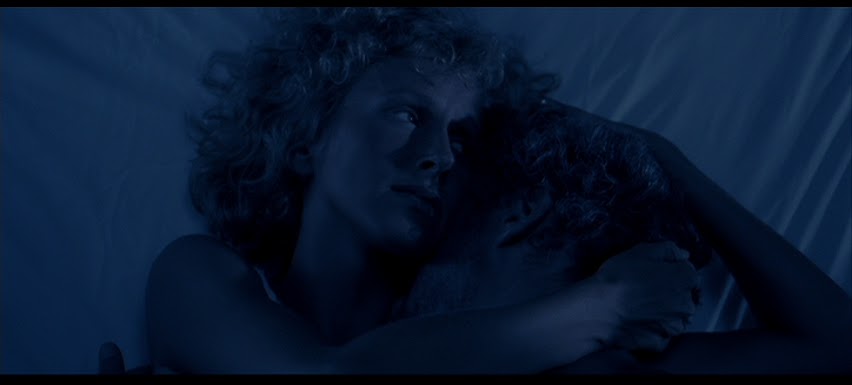
Above left: There is suggestion right from the beginning of the movie that Will is in some ways like the killer, the Tooth Fairy (Francis Dollarhyde). In an early scene in which Will and his wife, Molly, are in bed together, Will licks her neck several times (click image to enlarge). This is suggestive of what we later discover to be Dollarhyde's propensity for biting his female victims. Above right: A hard visual clue we are given of a likeness between Will and Dollarhyde is given in two scenes (taken together) which take place early in the movie: we notice that Graham follows the same path and sees the exact same physical objects on the steps leading to the Leeds family's bedrooms (as shown here), as did Dollarhyde when climbing these same steps in the scene before the movie title display. Since the Leeds family was one of Dollarhyde's victim families, the physical explanation for the two men's views being identical is that the crime scene has been preserved; but nevertheless, the fact that we, the Manhunter audience, are shown the two essentially identical scenes (Dollarhyde climbing the Leeds' stairs, and later, Graham climbing them), is to get across the idea that Graham is like the killer, in one or more respects.


a. Poster for Manhunter: The poster art copyright is believed to belong to the distributor of the film, De Laurentiis Entertainment Group, the publisher of the film or the graphic artist.
b. Wikipedia, 'Manhunter (film)'. Web, n.d. URL = https://en.wikipedia.org/wiki/Manhunter_(film).


Monday, August 22, 2011

2001 analysis - part 5: Hints from Tarantino's 'Pulp Fiction'

CATEGORY: MOVIES


Above left: Dr. Heywood Floyd 'celebrates' his daughter's birthday by video telephone communication with her, from the space station, on his way to the moon. Above right: Floyd's little girl as she appears to him while he's conversing with her. Left: The opening 'diner scene' from Pulp Fiction. 'Pumpkin' (aka 'Ringo'), seated on the right, and 'Honey Bunny' (aka Yolanda) are getting ready to rob the diner at gunpoint. During their pre-robbery discussion, Ringo describes to Yolanda a bank robbery scenario he previously heard about. This part of their conversation appears below.


Ringo: I heard about this one bloke, he walks into a federal bank with a portable phone, he gives the phone to the teller, the bloke on the other end of the phone says, 'We got this guy's little girl. If you don't give him all your money, we're gonna kill 'er'.

Yolanda: Did it work?

Ringo: Fuckin' A it worked, that's what I'm talkin' about. Knucklehead walks into a bank with a telephone, not a pistol, not a shotgun, but a fuckin' phone, cleans the place out, and they don't even lift a fuckin' finger.

Yolanda: Did they hurt the little girl?

Ringo: I don't know. There probably never was a little girl in the first place. W-well the point of the story isn't the little girl. The point of the story is, they robbed the bank with a telephone!!
---------------------------------------------

The little girl mentioned in the Pulp Fiction diner conversation is a reference to Heywood Floyd's daughter, and the idea of robbing a bank with a telephone is a hint that A Space Odyssey's Heywood Floyd is involved in some kind of 'robbery'.


Disclaimers
1) In certain instances it has been determined that the creators of some of the productions analyzed on this blog, and/or the creators of source material(s) used in the making of these productions, may be making negative statements about certain segments of society in their productions. These statements should be taken as expressing the opinions of no one other than the creators.

2) This blog is not associated with any of the studios, creators, authors, publishers, directors, actors, musicians, writers, editors, crew, staff, agents, or any other persons or entities involved at any stage in the making of any of the media productions or source materials that are analyzed, mentioned, or referenced herein.

3) In keeping with the policies of the filmmakers, authors, studios, writers, publishers, and musicians, that have created the productions (and their source materials) that are analyzed, mentioned, or referenced on this blog, any similarity of the characters in these films or source materials to actual persons, living or dead, is purely coincidental.

---------------------------------------------------------------------------------

All images on this blog are used solely for non-commercial purposes of analysis, review, and critique.

All Wikipedia content on this blog, and any edits made to it, are released under the Creative Commons Attribution-Share-Alike License 3.0.

Marcus Aurelius's Meditations - from Wikisource (except where otherwise noted); portions from Wikisource used on this blog are released under the Creative Commons Attribution-Share-Alike License 3.0.

Saint Augustine's Confessions and City of God from Wikisource (except where otherwise noted); portions from Wikisource used on this blog are released under the Creative Commons Attribution-Share-Alike License 3.0.

Saint Thomas Aquinas's Summa Theologica from the 'Logos Virtual Library' website (except where otherwise noted), compiled and edited by Darren L. Slider; believed to be in public domain.