On this site will be posted analyses of popular media productions. These analyses will have to do with determining the underlying meanings of various movies, songs, and certain novels. Methods used to analyze a given production will include exploration of the creators' use of symbolism, allegory, metaphor, etc., and deciphering any arcane or obscure references that it may contain.
Statue of Prague Golem created for the film Císaruv pekar — Pekaruv císar. [Image from the Wikipedia 'Golem' page; Clay-golem by Michal Maňas, licensed under CC BY-SA 2.5 via Wikimedia Commons.]
From the Wikipedia 'Golem' page:[a] In Jewish folklore, a golem is an animated anthropomorphic being, created entirely from inanimate matter. The word was used to mean an amorphous, unformed material in Psalms and medieval writing.
The most famous golem narrative involves Judah Loew ben Bezalel, the late 16th century chief rabbi of Prague, also known as the Maharal, who reportedly created a golem to defend the Prague ghetto from antisemitic attacks and pogroms. Depending on the version of the legend, the Jews in Prague were to be either expelled or killed under the rule of Rudolf II, the Holy Roman Emperor. To protect the Jewish community, the rabbi constructed the Golem out of clay from the banks of the Vltava river, and brought it to life through rituals and Hebrew incantations. As this golem grew, it became increasingly violent, killing gentiles and spreading fear. Some versions have the golem eventually turning on its creator or attacking other Jews.
Note that HAL is like a golem in that he was created from inanimate matter, and that he eventually becomes violent, turning on his creator, Man. According to the tale of the golem,
The Emperor begged Rabbi Loew to destroy the Golem, promising to stop the persecution of the Jews. To deactivate the Golem, the rabbi rubbed out the first letter of the word "emet" (truth or reality) from the creature's forehead leaving the Hebrew word "met", meaning dead.
Recall that Bowman 'kills' HAL by removing key components from his 'brain'. Finishing up with our brief summary of the golem tale,
The Golem's body was stored in the attic genizah of the Old New Synagogue, where it would be restored to life again if needed. According to legend, the body of Rabbi Loew's Golem still lies in the synagogue's attic.
---------------------------------------------------------------------------------------
In part 9 of the analysis of Peter Webber's 2007 film, Hannibal Rising (on this blog), it is explained that the young Hannibal Lecter is, metaphorically speaking, like a golem.
a. Wikipedia, 'Golem'. Web, n.d. URL = https://en.wikipedia.org/wiki/Golem.
Discovery One's pod bay doors open while Bowman waits to exit the spaceship in his EVA pod. This is an 'allegory' for the biblical whale vomiting out the prophet, Jonah, after he spent three days in the animal's belly.
In the analysis of Michael Mann's Manhunter, it was observed that there are quite a few mentions of the number three in Mann's movie, and it was determined that they are all references to the three days the biblical prophet, Jonah, spent in the belly of the whale. We will look at the story of Jonah below, but first, what needs to be realized is that Mann, in his use of the number three, is giving us a hint that Kubrick was doing the same thing in A Space Odyssey: Kubrick uses the number three to refer to Jonah and the whale, for example, when Elena mentions during the meeting in the space station that she and her colleagues have "just spent three months calibrating the new antennae at Tchalinko", and then later, during the Jupiter mission, when Frank Poole tells Mr. Amor that the bodies of the astronauts in hibernation on Discovery One are at a temperature of three degrees centigrade, and that their hearts beat three times per minute. Also, recall that when HAL announces the impending breakdown of the AE-35 unit, he states that the unit will go to one hundred percent failure within 72 hours. Since there are 72 hours in 3 days, this too is a reference to Jonah and the whale. The point is that part of Bowman's voyage on Discovery One, can be interpreted as being an allegory for the three days the biblical prophet, Jonah, spent in the whale's belly. A portion of the story of Jonah appears below, and is followed by a part of one interpretation of the story.
Jonah is the name given in the Hebrew bible to a prophet of the northern kingdom of Israel in about the 8th century BC, the eponymous central character in the book of Jonah, famous for being swallowed by a fish or a whale, depending on translation. The biblical story of Jonah is repeated in the Qur'an. The first part of the Story of Jonah runs as follows:
Jonah is ordered by God to go to the city of Nineveh to prophesy against it "for their great wickedness is come up before me."[Jonah 1:2, King James Version] Jonah seeks instead to flee from "the presence of the Lord" by going to Jaffa and sailing to Tarshish, which, geographically, is in the opposite direction. A huge storm arises and the sailors, realizing this is no ordinary storm, cast lots and learn that Jonah is to blame. Jonah admits this and states that if he is thrown overboard the storm will cease. The sailors try to dump as much cargo as possible before giving up, but feel forced to throw him overboard, at which point the sea calms. The inspired sailors then offer sacrifices to God. Jonah is miraculously saved by being swallowed by a large fish specially prepared by God where he spent three days and three nights. In chapter two, while in the great fish, Jonah prays to God in his affliction and commits to thanksgiving and to paying what he has vowed. God commands the fish to vomit Jonah out.
God again orders Jonah to visit Nineveh...(see here for the complete story).
Part of one early Christian interpretation of the story says that Jesus compares his generation to the people of Nineveh. Jesus fulfills his role as a type of Jonah, however his generation fails to fulfill its role as a type of Nineveh. Nineveh repented, but Jesus' generation, which has seen and heard one even greater than Jonah, fails to repent. Through his typological interpretation of the story of Jonah, Jesus has weighed his generation and found it wanting.
In the New Testament, Jonah is mentioned in Matthew and Luke. In the Gospel of Matthew, Jesus makes a reference to Jonah when he was asked for a miraculous sign by the Pharisees and teachers of the Law. Jonah's restoration after three days inside the great whale is said to prefigure the Resurrection of Jesus Christ after three days:[a]
But he answered and said unto them, An evil and adulterous generation seeketh after a sign; and there shall no sign be given to it, but the sign of the prophet Jonas: For as Jonas was three days and three nights in the whale's belly; so shall the Son of man be three days and three nights in the heart of the earth. The men of Nineveh shall rise in judgment with this generation, and shall condemn it: because they repented at the preaching of Jonas; and, behold, a greater than Jonas [is] here. [Matthew 12:39-41, King James Version; material inside square brackets in original source (blueletterbible.org).]
a. Wikipedia, 'Jonah'. Web, n.d. URL = https://en.wikipedia.org/wiki/Jonah.
Stanley Kubrick at the age of 21. [Image from the Wikipedia 'Stanley Kubrick' page, public domain, via Wikimedia Commons.]
Stanley Kubrick was born on July 26, 1928, at the Lying-In Hospital in Manhattan, New York, the first of two children of Jacques (Jacob) Leonard Kubrick (1901–85) and his wife Sadie Gertrude (née Perveler; 1903–85), who were both Jewish. When the critic Michel Ciment asked him whether he had a religious upbringing, Kubrick replied "No, not at all."[a] He had no bar mitzvah and did not attend synagogue, like many Jews who led secular lives.
Nevertheless, Kubrick's family and many critics felt that his Jewish ancestry may have contributed to his worldview and aspects of his films. His daughter noted that he wanted to make a film about the Holocaust, to have been called Aryan Papers, having spent years researching the subject. (Kubrick later noted that Steven Spielberg's Schindler's Listcovered much of the same material.) Most of his friends and early photography and film collaborators were Jewish, and his first two marriages were to daughters of recent Jewish immigrants from Europe.[b]
Before we connect A Space Odyssey with Hannibal Lecter, in order to begin to see what kind of statement Kubrick was making about certain evil Jews, we need to look at some basic information on Lecter:
Hannibal Lecter M.D. is a fictional character in a series of thriller novels by Thomas Harris and in the films adapted from them. Lecter was introduced in the 1981 thriller novel Red Dragon as a brilliant psychiatrist and cannibalistic serial killer. The novel and its sequel, The Silence of the Lambs, features Lecter as the true antagonist after the other two serial killers of each story. In the third novel, Hannibal, Lecter becomes the main character. His role as the antihero occurs in the fourth novel, Hannibal Rising, which explores his childhood and development into a serial killer.
Shown at left is Anthony Hopkins as Hannibal Lecter in The Silence of the Lambs. The first film adapted from the Harris novels was Manhunter (based on Red Dragon), featuring Brian Cox as Lecter, spelled "Lecktor." In 2002, a second adaptation of Red Dragon was made under the original title, featuring Anthony Hopkins, who had played Lecter in the motion pictures The Silence of the Lambs and Hannibal. Hopkins won an Academy Award for The Silence of the Lambs in 1991.[c]
Note the similarity of the first letters of HAnnibal Lecter's name to 'HAL' - this is one indication that at least some of the Lecter movies are related to A Space Odyssey. In the analysis of The Silence of the Lambs (on this blog), it was observed that Hannibal Lecter represents Satan personified. Since HAL is a Satan figure, there is a correspondence between Lecter and HAL: Since Lecter also represents an evil Jew, the makers of The Silence of the Lambs are here giving us a hint that HAL himself represents, in part, an evil Jew. The battle between David Bowman and HAL is a clear reference to the battle between David and Goliath, with Bowman representing his namesake, the future king of the Jews. Taking this together with the aforementioned clue from The Silence of the Lambs, Bowman represents a 'good Jew' and HAL represents a 'bad Jew'. Since HAL is a Satan figure, we see that Kubrick is drawing some correspondence between evil Jews, and Satan.
Above left: A closeup of HAL's camera 'eye'. Above right: A common symbol of Freemasonry, the circumpunct, consists of a dot inside a circle with two vertical lines, one on either side of the circle. Taking the dot in the figure to correspond (graphically) to the red dot in the view of HAL's eye shown at above left, we see that HAL not only represents an evil Jew/Satan figure, but he also represents evil Freemasons.
In The Silence of the Lambs, serial killer Jame Gumb (shown at left) represents Satan's (i.e., Lecter's) 'pupil': As explained in the analysis of The Silence of the Lambs, he represents the Freemasons. Gumb desires to 'usurp' Lecter's place as a personification of Satan. 2001's HAL, representing a 'combination' of an evil Freemason and an evil Jew, desires to usurp the place of Satan himself.
Above left: Bowman requests that HAL open the EVA pod bay doors, so that he can get back onto Discovery One, but HAL refuses. Above right: Once Bowman gets back on board the ship through the emergency airlock, he proceeds to disconnect HAL's 'brain'. As implied above, the battle between Bowman and HAL is one between a 'good Jew' and a 'bad Jew', respectively. The battle's outcome has something to do with Bowman's psychology; this will be explored later in the analysis.
In subsequent posts in this analysis, we will see more evidence for a connection between certain Lecter movies and 2001, as well as more evidence that in his movie, Kubrick depicts certain Jews as evil.
a. Kubrick on The Shining, An Interview with Michel Ciment. Web. URL = http://www.visual-memory.co.uk/amk/doc/interview.ts.html.
b. Wikipedia, 'Stanley Kubrick'. Web, n.d. URL = https://en.wikipedia.org/wiki/Stanley_Kubrick.
c. Wikipedia, 'Hannibal Lecter'. Web, n.d. URL = https://en.wikipedia.org/wiki/Hannibal_lecter.
From David Lynch's Mulholland Drive: Diane Selwyn has a dream in which we see a pool cleaner's pickup truck parked at Adam Kesher's house. The pool-man is inside the home, cheating in bed with Adam's wife. The words 'Gene Clean' painted on the side of the truck refer not only to Gene the pool man in Mulholland Drive, but also, the missing word, 'pool', is a reference to Frank Poole's last name, and ultimately to the idea of cleaning a (human) gene pool, which was effectively what the Nazi's supposedly believed they were doing by attempting to exterminate the Jews just before and during World War II.
Lynch is here giving us a clue about Frank Poole's last name being a reference to the general populace (i.e., 'gene pool'). The clue is also a reference to the situation with the Nazis and Jews, as indicated above, and Lynch believes Kubrick was making some sort of statement on this subject (i.e., the subject of the Jews and Nazis) in A Space Odyssey.
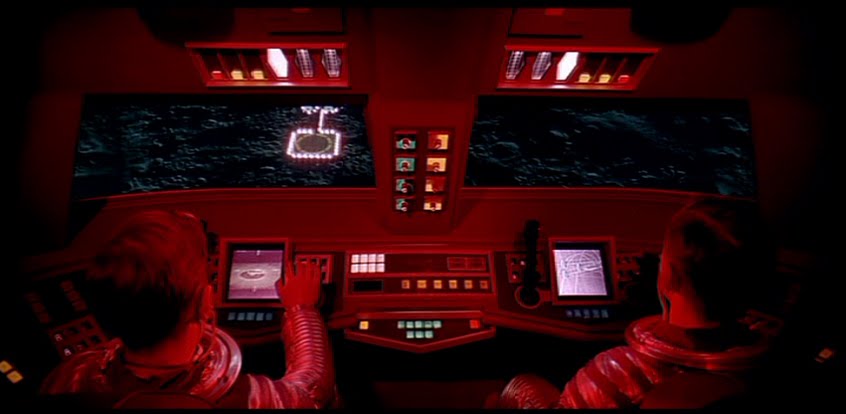
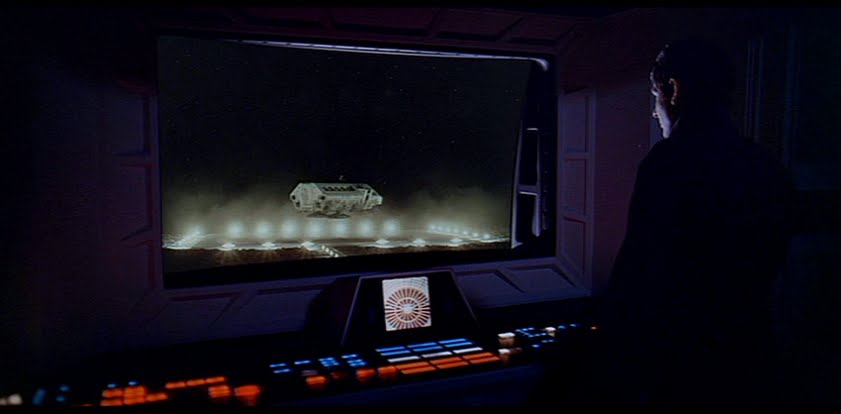
Top left: The red coloring of the moonbus cockpit represents the fires of Hell, indicating that the two men piloting the bus are are hit men, sent by Satan, to retrieve the monolith contents from the aliens. Top right: The three men in the passenger compartment of the bus, Heywood Floyd (sitting at left), the man sitting to Floyd's right, and the man standing (who says that he "thinks it's chicken" in his sandwich), are all aliens, i.e., their minds and bodies are 'inhabited' by alien life forces. One of the aliens (but not Heywood Floyd) is an informant, working undercover for Satan. Recall that in part 14 of the analysis, we noted that Carl Jung says that the color blue represents the feminine, and that the blue in back of the moonbus indicates that the aliens are feminine in nature. Above left: The man standing at the landing pad control panel when the moonbus arrives, looks like David Bowman in profile (you may click on the screencap to enlarge it). The fact is that this man is Bowman, and he is one of the six astronauts who visits the monolith (the other five being the men who arrived in the moonbus). Above right: The six astronauts at the excavation site. In this view, the men are holding their hands at their sides in such a manner as to suggest that they are about to draw guns, as if there's an element of 'wild West' here. This foretells what is to happen when the men descend into the excavation.
As stated earlier, there is a nigredo at TMA-1 beginning when the monolith starts making a high-pitched noise. Immediately subsequent to this, there is a 'face-off' among the six astronauts, with some of them being killed, by having their air hoses disconnected. For reasons that will be explained later, the 2001 audience does not see this part of the action. We know that Bowman survives this 'showdown' at TMA-1, since eighteen months later, he's on Discovery One.
There is some amount of 'body-hopping' going on among the aliens with respect to men's bodies, at certain points in 2001 - we know that the alien individual who earlier occupied Floyd's body, later inhabits that of Bowman. What happens at TMA-1 is that when some of the men whose bodies are occupied by alien individuals are killed, the aliens within them are not killed; they merely leave the bodies they were occupying, as pure, sentient energy.
The portion of the meninges surrounding the brain: dura mater, arachnoid mater and pia mater. [Image from the Wikipedia 'Meninges' page, public domain, via Wikimedia Commons.]
In part 13 of this analysis, we observed that David Bowman suffers a subdural hematoma, which is a type of traumatic brain injury, when he is 'ejected' into the emergency airlock of Discovery One and hits his head on the airlock wall. To get a better physical picture of where the internal bleeding from this injury occurs, we refer to the above diagram, which shows the meninges, the system of membranes that envelops the central nervous system including the brain. When a person has suffered a subdural hematoma, blood collects between the dura mater and the arachnoid mater, creating intracranial pressure,[a] and thus causing (in Bowman's case) the symptoms we talked about in part 13. However, there is also evidence that Bowman has suffered a subarachnoid hemorrhage, in which blood collects between the arachnoid mater and the pia mater. The pia mater is a very delicate membrane. It is the meningeal envelope which firmly adheres to the surface of the brain and spinal cord, following the brain's minor contours. The evidence that Bowman has experienced a subarachnoid hemorrhage (in addition to his subdural hemorrhage) is described below. (Note that the terms 'hemorrhage' and 'hematoma' are interchangeable).
Top left: Bowman sees this very bright white light while in the stargate. Top right: Bowman's eye is shown while he's viewing this bright light. Note the size of the pupil. Above left: A short while later, Bowman arrives at a point where there is very little light. Above right: Bowman viewing the dark area at left. Note the lack of pupillary light reflex - the pupil of Bowman's eye should have gotten much larger at this point, than it was when he was viewing the bright light; whereas, in fact, it has actually gotten slightly smaller. This lack of pupillary light reflex is one symptom of a subarachnoid hemorrhage. As stated above, a subarachnoid hemorrhage (SAH) is bleeding into the subarachnoid space — the area between the arachnoid membrane and the pia mater surrounding the brain. This may occur spontaneously, usually from a ruptured cerebral aneurysm, or may result from head injury. Up to half of all cases of SAH are fatal and 10–15% of casualties die before reaching a hospital, and those who survive often have neurological or cognitive impairment.[b] As with the subdural hemorrhage, the pressure of the collected blood from the hematoma exerts pressure on the brain. Intraocular hemorrhage (bleeding into the eyeball) may occur in response to the raised pressure. The small round spot just above and to the left of Bowman's pupil (from our perspective), must be due to bleeding into the eye.
Michael Mann has inserted hints into some of his movies that Bowman suffers a brain hemorrhage, and an intraocular hemorrhage as well. For example, in Thief, Frank mentions that someone he knew in prison died from a cerebral hematoma. And, in Manhunter and Heat, there is mention of murder victims suffering eight-ball hemorrhages. An eight-ball hemorrhage is a hyphema in which the anterior (i.e., front) chamber of the affected eye is completely filled with blood. Bowman's eye chamber is not completely filled with blood (yet), but the point is that Mann is giving a hint about intraocular bleeding.
a. Wikipedia, 'Subdural hematoma'. Web, n.d. URL = https://en.wikipedia.org/wiki/Subdural_hematoma.
b. Wikipedia, 'Subarachnoid hemorrhage'. Web, n.d. URL = https://en.wikipedia.org/wiki/Subarachnoid_hemorrhage.
Above left: Bowman moves across Discovery One's emergency airlock at a high rate of speed, after 'ejecting' into it from his EVA pod. Note the lighting in the airlock, and the alternating white-black patterns on the walls. Above right: Bowman disconnects HAL. Note the numerous, colored 'slits' of light. The point is that the patterns of light Bowman sees in these two scenes, form part of the source for what he physically sees as he moves through the stargate. It's as if while he's in the stargate, he's seeing (somewhat distorted) 'after-images' of some of the things he had seen shortly before the stargate's beginning.
Top left: Bowman, along with the alien life force inhabiting his body, is about to exit Discovery One near Jupiter. The monolith is floating nearby. Top right: Bowman's physical movement through the stargate is actually movement through a wormhole connecting Jupiter space with Earth space. A wormhole is a hypothetical feature of spacetime that would be, fundamentally, a "shortcut" through spacetime. When Bowman moves through the wormhole, he is taking a shortcut between Jupiter space and Earth space, and he is also going backward in time - the wormhole connects not only two different regions of space, but two different times as well. Evidently, the aliens have the ability to create wormholes. Above left: Once Bowman is near the Earth's surface, he sees blue sky and clouds. Above right: Shortly after this, he sees some rock formations.
Gustave Dore's image of the beatific vision, from Dante Alighieri's Divine Comedy. In Christian theology, the beatific vision is the eternal and direct visual perception of God. [Image from the Wikipedia 'Beatific vision' page, public domain, via Wikimedia Commons.]
Above: Bowman sees various patterns of bright white light while in the stargate, thus indicating that he is experiencing the beatific vision.
The beatific vision (Latin: visio beatifica) – in Christian theology is the ultimate direct self communication of God to the individual person, when she or he reaches, as a member of redeemed humanity in the communion of saints, perfect salvation in its entirety, i.e. heaven. The notion of vision stresses the intellectual component of salvation, though it encompasses the whole of human experience of joy, happiness coming from seeing God finally face to face and not imperfectly through faith (1 Cor 13:11–12).
It is related to the Catholic and Eastern Orthodox belief in theosis, and is seen in most – if not all – church denominations as the reward for Christians in the afterlife.
Christianity While humans' understanding of God while alive is indirect (mediation/prayer, not actually looking at Him), the beatific vision is direct (immediate, visual), or literally, seeing God. In other words, the beatific vision means a soul is actually looking at God, as is, viewing Him without any sort of censorship like that depicted by the prophet Isaiah.
History of the beatific vision In Christianity, the bible teaches that God "dwells in unapproachable light, whom no one has even seen or can see" (1 Timothy 6:16), but when God reveals Himself to us in heaven we will then see Him face to face (1 Corinthians 13:12; Matthew 5:8; Psalms 17:15). This concept has been termed "the beatific vision of God" by theologians of the Catholic Church, as well as various Protestant denominations, including the Lutheran Church and the Methodist Church.
Platonism
In the philosophy of Plato, the beatific vision is the vision of the Good.
Hinduism The vedic concept of having a visual perception of God is generically called Darshan.
Islam
Sunni Islam also has the idea of beatific vision. The Qur'an speaks of believers seeing Allah in paradise.[a]
a. Wikipedia, 'Beatific vision'. Web, n.d. URL = https://en.wikipedia.org/wiki/Beatific_vision.
Above left: Character Susan Blue (near center, wearing red shirt) appears to die in this scene from Lynch's Inland Empire. However, the scene is revealed to be a 'movie within a movie' when we see camera equipment (far right of photo) coming into view. Susan Blue is 'played' by character Nikki Grace, who is in turn played by real-life actress Laura Dern (i.e., Dern plays both Nikki and Susan). The movie being filmed within Inland Empire is called On High in Blue Tomorrows. This scene constitutes a hint from Lynch that A Space Odyssey itself contains a movie within a movie, implying that some aspect of 2001 is 'faked'; for example, what we see as the Jupiter mission, or some part of it, is actually a movie being filmed (or a program being broadcast) within A Space Odyssey, designed to fool some group of persons who will be viewing it. Above right: Although there should be zero gravity in the pod bay, while Poole and Bowman are working on the AE-35 unit, the two men are leaning on the table in a manner suggesting that they are being held down by gravity, while they examine the (supposedly) faulty unit. We do know the unit has something to do with the communications antenna; this antenna must be what is being used to communicate the aforementioned broadcast. We also know that HAL's camera 'eyes' are installed at various places throughout the ship; it's these very camera eyes that are being used to record the film, and/or to convey the broadcast, of the mission.
Above left: At one point during the stargate sequence, Bowman sees seven diamond-shaped objects. Each object constitutes a regular octahedron (an object consisting of eight equal, symmetrically-placed faces). The regular octahedron is one of the five Platonic solids, which feature prominently in the philosophy of Plato for whom they are named. Plato wrote about them in the dialogue Timaeus circa 360 B.C., in which he associated each of the four classical elements (earth, air, water, and fire) with a regular solid. The octahedron was associated with air.[a] As indicated in the previous post, the red coloring 'flowing' under the objects represents the river Styx. In Greek mythology, the Styx formed the boundary between Earth and the underworld. As stated, Bowman sees seven octahedra. The number seven is used in certain places in the bible, especially in the book of Revelation. Also, in Greek mythology, there are seven guards of the underworld; recall that we said Bowman is moving through the circles of Hell when he moves through the stargate. There are seven lights in the Jewish Temple Menorah, and there are seven classical planets as well. Note that if we combine the menorah symbolism with the 'guards of the underworld' symbolism, then Kubrick is depicting evil Jews as the guardians of Hell. Above right: Initially, only five of the seven bipyramids are in view (this shot is from just prior in the stargate sequence to the one at left). In this shot, each object now has its top and bottom portions overlapped with each other.
Above left: When viewed from the side, each of the seven octahedra shown in the left-hand screencap at the top of this post (the screencap showing seven diamonds), appears as shown here (two equal triangles attached at their bases). Above center: If we overlap the two triangles to obtain each the five objects shown in the right-hand screencap at the top of the post, by moving the top triangle down and the bottom one up, we obtain a hexagram. The Jewish Star of David is itself a hexagram; this indicates that the seven diamond-shaped objects do, in fact, represent the seven lights of the Jewish Temple Menorah. The Dictionary of Symbols contains an entry for Star of David which explains the symbolism of the Star's center region (outlined in bold in the figure): "[I]n Hermetic tradition, the Star of David...encompasses the seven basic metals, that is the totality of metal, as well as the seven planets which epitomize the totality of the Heavens. The centre...is occupied by gold (Sun); the upper point by silver (Moon) and the lower by lead (Saturn). On the right, the upper point is copper (Venus); the lower, mercury (Mercury), while on the left the upper point is iron (Mars) and the lower tin (Jupiter)."[b] Also, note that the interior border of our hexagram (again, outlined in bold) forms a regular hexagon. There are several hexagonal-shaped objects in the movie, such as the three rear thrusters on Discovery One (pictured above far right; note the slight elongation in the vertical direction of each hexagon). The hexagons in the movie can be taken to represent the sun, since their basic shape matches the central interior geometric region of the Star of David, which, as noted above, is symbolically "occupied by gold (sun)." As we will see later in the analysis, the disproportionate extension in the vertical direction of many of the movie's hexagonal shapes, represents an emphasis on the unconscious mind over the conscious, and therefore, an emphasis on the feminine over the masculine.
Above left: Discovery One is physically shaped somewhat like a human body (click image to enlarge), with the spherical section at the front of the ship being the head, and the long row of segments connecting the sphere with the rear of the ship, appearing similar to a spinal column with its vertebrae. Above right: Within the context of Discovery One representing a human body, the three pairs of round rocket nozzles at the rear represent three pairs of excretory orifices. When we combine this with the idea of the inner part of a Star of David being a hexagon, and with the fact that the Discovery One rocket orifices are inside hexagons, then Kubrick must be saying that 'evil Jews are dumping shit into the universe' or that they are 'powered by shit', or something of that nature.
Above: We can take the above physiological description of Discovery One even further, when we observe that the small, round EVA pods, returning to Discovery One's spherical 'head' via the three circular openings to the pod bay, each of which symbolizes a 'mouth' to go with one of the three pairs of excretory orifices at the rear of the ship, represent feces (i.e., 'turds'), entering the 'mouth' of the ship, with each returning pod landing on the 'tongue' protruding from the round 'mouth' prior to being brought inside the ship. Kubrick is saying that the aforementioned evil Jews eat shit, or else he's telling them to eat shit.
a. Wikipedia, 'Platonic solid'. Web, n.d. URL = https://en.wikipedia.org/wiki/Platonic_solid.
b. Dictionary of Symbols. Ed. Jean Chevalier and Alain Gheerbrant, Trans. John Buchanan-Brown. London: Penguin Group, 1996. pp. 930-931.
Disclaimers 1) In certain instances it has been determined that the creators of some of the productions analyzed on this blog, and/or the creators of source material(s) used in the making of these productions, may be making negative statements about certain segments of society in their productions. These statements should be taken as expressing the opinions of no one other than the creators.
2) This blog is not associated with any of the studios, creators, authors, publishers, directors, actors, musicians, writers, editors, crew, staff, agents, or any other persons or entities involved at any stage in the making of any of the media productions or source materials that are analyzed, mentioned, or referenced herein.
3) In keeping with the policies of the filmmakers, authors, studios, writers, publishers, and musicians, that have created the productions (and their source materials) that are analyzed, mentioned, or referenced on this blog, any similarity of the characters in these films or source materials to actual persons, living or dead, is purely coincidental.
Saint Augustine's Confessions andCity of God from Wikisource (except where otherwise noted); portions from Wikisource used on this blog are released under the Creative Commons Attribution-Share-Alike License 3.0.
Saint Thomas Aquinas's Summa Theologica from the 'Logos Virtual Library' website (except where otherwise noted), compiled and edited by Darren L. Slider; believed to be in public domain.