Thursday, February 2, 2012

2001 analysis - part 14: Hints from David Lynch; color symbolism; 'prostitution'

CATEGORY: MOVIES


Four screen captures from David Lynch's film, Mulholland Drive: Top left: Diane Selwyn answers the phone by the red lampshade. Diane is a call-girl, and she operates out of the rooming house pictured here. In Mulholland Drive, Lynch associates the color red with prostitution. Top right: Rita, who represents Diane's subconscious (i.e., her unconscious), has opened the blue box. The 'staircase' structure on the inside top of the box indicates that the box represents the 'container' for Diane's Jungian Self. The Self, according to Swiss psychologist and psychiatrist Carl Jung, is realized as the process of individuation, which in Jungian view is the process of integrating one's personality.[a] The Self manifests itself in "wholeness," a point in which a person discovers his or her true nature.[b] Above left: Diane has a dream in which a prostitute, a hit man (far left), and a pimp are exiting a hot dog eatery called Pink's. Note the red items: the fire department vehicle at right, the red pole entering into view at right (click image to enlarge), and the red 'Aaron Brothers' sign across the street (at upper left of screencap). Above right: The prostitute, who represents Diane in the dream, gets ready to climb into the back of the hit man's blue van. What's being done with the colors in this scene is that Lynch is associating redness, and thus prostitution, with the blue, which represents Diane's Self - the blue box is linked to the blue van, and Diane's true nature is that she is a prostitute.


From A Space Odyssey: Above left: The lunar lander cockpit. Note the red 'glow' - Lynch's association of the color red with prostitution is to be taken as a hint about 2001, and he must believe Kubrick is saying something along the lines of 'certain women are serving as prostitutes', within the context shown here (i.e., space travel). The food on the trays being served to the men by the stewardess here, is to be eaten through straws. Above right: The passenger compartment in the moonbus, has a blue theme here, a fact which is reminiscent of the blue van in Mulholland Drive, but note the red glow coming from the cockpit. In this case, the red symbolizes the fires of Hell, and thus represents the 'presence' of Satan.[c] Heywood Floyd is one of the three passengers in the back of the bus (he is sitting at far left in the screencap). Since his body is occupied by an alien life force, and since, as is evident from the dialogue in this scene, he's working closely with the two men next to him, it must also be the case that these other two men's bodies are occupied by alien life forces.


As shown at left, the men in the moonbus have gotten their own food (which is solid) out of a container. Again, note the blue color scheme in the rear of the moonbus - Jung says (in his Psychology and Alchemy) that the color blue symbolizes the feminine;[d] the implication is that the aliens are feminine in nature.


Closer examination of the lunar lander cockpit activity, reveals Kubrick's intended message about 'prostitution in space':


Top left: When the stewardess first steps into the cockpit of the lander, the perspective is upside-down, i.e., it is inverted. In Part 1 ("The Sexual Aberrations") of his Three Essays on the Theory of Sexuality (1905), Sigmund Freud referred to the practice of homosexuality as "inversion." Top right: Once the stewardess is fully inside the cockpit, the camera perspective begins to rotate. Above left: Once things have been 'righted', they are no longer inverted; the symbolism here is that the female's entry into the cockpit eliminates the 'gayness' of the environment. Notice that the waist strap of the copilot's harness is higher up on his body, than is that of the pilot. The copilot will thus be able to quickly undo his pants; it is his 'turn' to have 'quickie' sex with the stewardess. Above right: The stewardess snuggles up to the copilot just before having sex with him. The point is that Kubrick predicted that as space travel became more common, women would be inserted into the space program to serve as 'prostitutes' for the male astronauts, one reason for this being to avoid a situation where the men would have gay sex with each other (due to their being confined together for long periods of time away from their spouses and other females).


Above left: We are shown an external view of the lander traveling, while the aforementioned sex is taking place. Above right: After having had sex, the hands of the copilot, as well as those of the stewardess (who is now sitting in a rear seat in the cockpit), are positioned as if covering their respective genital areas. This indicates that they are both embarrassed due to their mutual act. The source of this embarrassment is not only the 'quickie' aspect of the sex, but also, for the copilot, the fact that he has cheated on his regular partner back on Earth or on the space station; and for the stewardess, the sinking in of the fact that she has been hired primarily to provide sex.


The name itself of the Pink's hot dog eatery in Mulholland Drive (above left), serves as a hint that the woman (dressed in pink) greeting Heywood Floyd in the space station kiosk area (above right), is also serving as a 'space prostitute'.


Elena's two female colleagues (but not Elena herself), have been put in space to provide sex for the males. Kubrick predicted that even certain female professionals, such as astronauts and scientists, would be placed not only to perform technologically complex job functions, but also to provide sex for male astronauts.


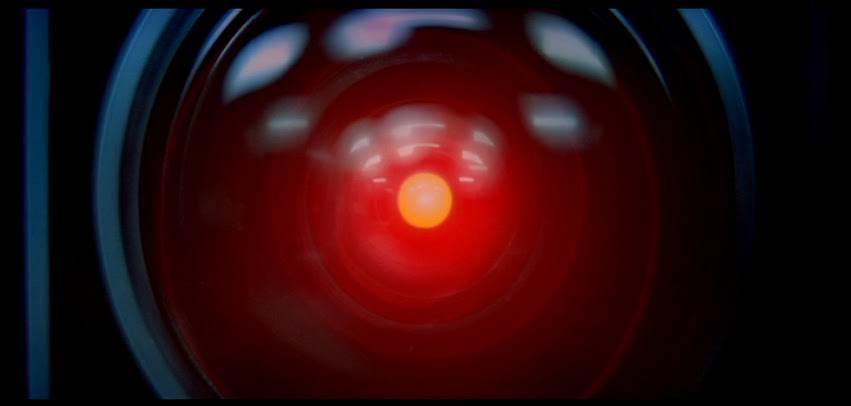
Bowman disconnects HAL. Note the similarity of the name 'HAL' to the word 'Hell'; the red here represents the fires of Hell, again indicating the 'presence' of Satan. The implication is that HAL represents a Satan figure.


a. Wikipedia, 'Self in Jungian psychology'. Web, n.d. URL = https://en.wikipedia.org/wiki/Self_in_Jungian_psychology.
b. Wikipedia, 'Rubedo'. Web, n.d. URL = https://en.wikipedia.org/wiki/Rubedo.
c. It's true that certain real-life transport craft use red lighting as a vision-enhancement mechanism for the person(s) operating the craft, but this doesn't exclude the fact that Kubrick was also using the color red for symbolic purposes.
d. Jung, C.G. The Collected Works of C.G. Jung, Vol. 12. Princeton University Press, 1968. paras. 320-321.


Wednesday, February 1, 2012

2001 analysis - part 13: Bowman suffers a brain injury

CATEGORY: MOVIES


Top left: David Bowman is 'ejected' from his EVA pod into the emergency airlock of Discovery One. Top right: Bowman then careens across the airlock at a high rate of speed, and hits his head on the opposite wall. Above left: We observe that Bowman's breathing is irregular and his body motions are lethargic while he's disconnecting HAL. Above right: Bowman experiences deviated gaze while in the 'stargate'.


Bowman's symptoms after hitting his head (lethargy, irregular breathing, and deviated gaze) indicate that he's suffering from a subdural hematoma (also known as a subdural hemorrhage), which is a type of traumatic brain injury. Subdural hemorrhages may cause an increase in intracranial pressure (ICP), which can cause compression of and damage to delicate brain tissue. Subdural hematomas are often life-threatening when acute. Acute bleeds often develop after high speed acceleration or deceleration injuries and are increasingly severe with larger hematomas. The mortality rate associated with acute subdural hematoma is around 60 to 80%. [a] Note that most of the airlock wall is padded, but that Bowman has hit his head on an unpadded portion of the wall. Also, he has hit the top of his head, which is why we don't see external evidence of an injury, since any bruising or rupture of the skin would be covered up by his hair (and then later by his space helmet after he puts it on).


A few seconds after Bowman has hit his head on the airlock interior, he has no visible blood streaming down his face. His head injury is more internal than it is external.


A few seconds after the above view, the camera cuts to HAL (below left) for a few moments, then there is a fade to Bowman wearing a space helmet (below right). Again, we can't see any external evidence of an injury - if anything has begun to develop or collect on the outside of the top of Bowman's head by this point, such as some matted blood, we can't see it, due to the fact that he's wearing the helmet.


Much later than the above, while Bowman is standing in the 'hotel' room after having passed through the stargate, there is still no visible blood on his face. This is because, again, the actual injury he has suffered is mainly an internal one; any external blood has not collected in an amount sufficient to start running down his face.


a. Wikipedia, 'Subdural hematoma'. Web, n.d. URL = https://en.wikipedia.org/wiki/Subdural_hematoma.


Friday, January 27, 2012

2001 analysis - part 12: The 'Dawn of Man' is set in Mexico, not Africa

CATEGORY: MOVIES


Shown at left is the opening title of A Space Odyssey's 'Dawn of Man' segment; note that the setting (i.e., the time period and location) are not specified. Though it's true that Arthur C. Clarke's novel, 2001: A Space Odyssey, which was developed alongside Kubrick's movie, places the Dawn of Man segment in Africa, the fact is that Kubrick had complete control over the movie, and in fact, he set the Dawn of Man at a different geographical location, as described below.


The pig-like creatures shown in the Dawn of Man sequence, are called tapirs. There is no evidence of tapirs ever naturally existing in Africa; they have, instead, lived in Asia and the Americas. The first true tapirs appeared in the Oligocene Epoch, and by the Miocene Epoch, such genera as Miotapirus were almost indistinguishable from the extant species. It is believed that Asian and American tapirs diverged around 20 to 30 million years ago, and that tapirs migrated from North America to South America around 3 million years ago, as part of the Great American Interchange. Thus, they would have passed through what is now Mexico, at some point during the Pliocene Epoch, which spans the interval from about 5.3 million to 2.6 million years ago. For much of their history, tapirs were spread across the northern hemisphere, where they became extinct as recently as 10,000 years ago.[a] What this means for our analysis is that the Dawn of Man is not set in Africa. At this point, what we must do is determine whether it is set in Asia, North America, Central America, or South America.


The skull with tusks shown at left is that of a young American mastodon, a species that inhabited North and Central America during the late Miocene or late Pliocene, up to their extinction at the end of the Pleistocene Epoch 10,000 to 11,000 years ago. Mastodons were predominantly forest dwelling animals, and thus, no living American mastodons would have occupied the relatively barren landscape depicted in the movie. This landscape became barren due to the disappearance of forest areas, which was in turn due to climate cooling during the Pliocene, and remnants of dead mastodons were left behind.[b] We have now narrowed down the setting of the Dawn of Man to North America or Central America.


Female and calf American mastodon at the George Page Museum. [Image from the Wikipedia 'Mastodon' page; La Brea Mastodons by daryl_mitchell from Saskatoon, Saskatchewan, Canada, licensed under CC BY-SA 2.0 via Wikimedia Commons.]


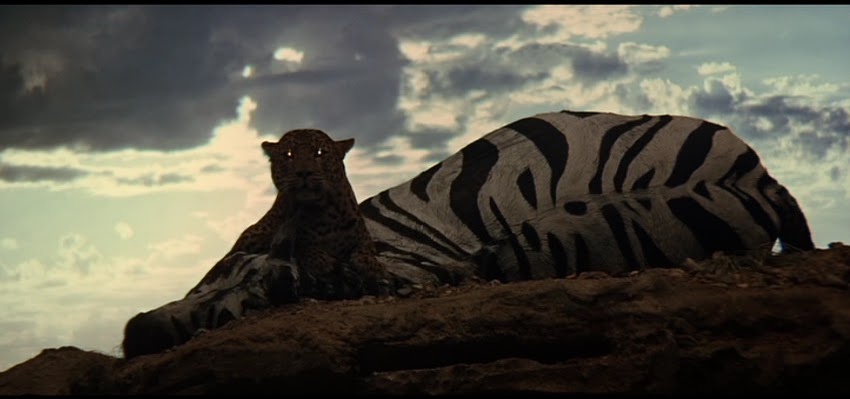
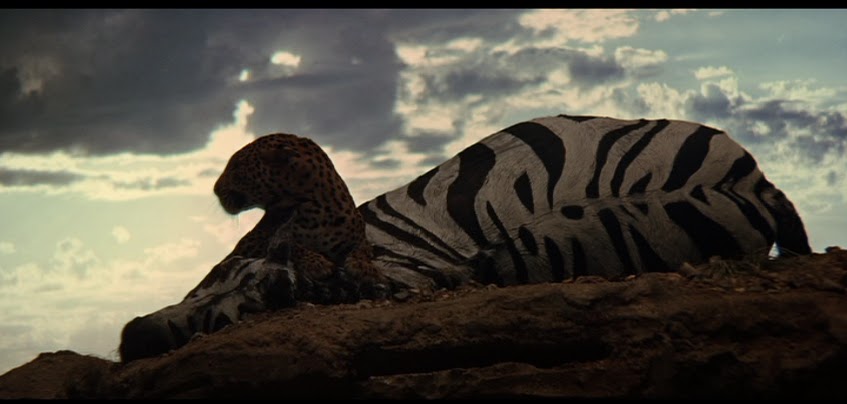
The movie's big cat (shown at above left, attacking an ape-man, and above right, sitting over large prey), is commonly assumed to be a leopard, but it is, in reality, a jaguar. The movie's cat has predominantly medium- to dark-orange body coloring (click above images to enlarge), like a jaguar (below left), instead of having lighter coloring, as does the African leopard (below right). Also, notice that the area below the leopard's neck is white, while in the above right and below left screencaps, it can be seen that this area is darker in the jaguar.


Above left: The jaguar, a native mammal of Mexico. [Image from the Wikipedia 'Mexico' page, public domain, via Wikimedia Commons.] Above right: African leopard at the Moremi Game Reserve, Botswana. [Image from the Wikipedia 'Leopard' page; African Leopard 5 by DanH, licensed under CC BY-SA 3.0 via Wikimedia Commons.]


As shown at left, when the movie's jaguar finishes off the ape-man he has attacked, he does so by going for the upper back area of the ape-man's head, instead of, say, for his throat. A jaguar has an exceptionally powerful bite, even relative to the other big cats. This allows it to pierce the shells of armored reptiles and to employ an unusual killing method: it bites directly through the skull of prey between the ears to deliver a fatal bite to the brain.


The leopard inhabits only forested and bushy regions, while the jaguar is known to inhabit regions which include scrublands and deserts, like those of the Dawn of Man segment of A Space Odyssey. The jaguar can also inhabit forests. The jaguar, Panthera onca, is the only existent New World member of the Panthera genus. The jaguar's present range extends from the Southern United States and Mexico across much of Central America and south to Paraguay and northern Argentina. The historic range of the species included much of the southern half of the United States, and in the south extended much farther to cover most of the South American continent. The fossil record points to the emergence of Panthera just 2 to 3.8 million years ago.[c][d][e][f] The foregoing is consistent with the Dawn of Man being set somewhere in North or Central America.


The large striped animal the jaguar is sitting over is an American zebra. This animal is described below.


The American zebra (Equus simplicidens) was a North American species of equid from the Pliocene and the Pleistocene epochs. Remains of it have been discovered in various locations in North American, including in the western part of the Mexican state of Chihuahua, at the Miñaca Mesa. The Miñaca remains date from the North American land mammal age known as the Blancan age.[g] The Blancan age lasted from about 4 million years ago, to 1.9 million years ago. According to Kurten,[h]

"The beginning of the Blancan age is marked by the appearance of a horse of modern type ([the American Zebra]) and by temporary emergence of the Bering land bridge, with resulting intermigration between the New World and the Old...

"The American zebra has been known to science since 1892, when [American paleontologist Edward Drinker Cope] published his description of Equus simplicidens...The name, "simple-toothed", alludes to the enamel pattern of the cheek teeth, which is simple in comparison with that of many other horses...

"[Experts agree that Equus simplicidens] is closely related to the living African species called Grévy's zebra (Equus Grevyi). It is the largest of today's zebras, standing up to six feet at the shoulders. It has large ears, somewhat reminiscent of a donkey, and a long, narrow muzzle. The black stripes are narrower and more densely spaced than in other zebras, which gives the animal a greyish look from a distance. A striking feature is a longitudinal black stripe along the back, separated from the vertical stripes by a white band. We do not know whether this pattern, or anything like it, was present in the American species, but the long narrow muzzle is the same...The other living zebras are more distantly related to the simplicidens-grevyi group."

Note that Kubrick depicts the American zebra as having stripes.


Grévy's zebra stallion. [Image from the Wikipedia 'Grévy's zebra' page; Grevy's Zebra Stallion by Rainbirder, licensed under CC BY-SA 2.0 via Wikimedia Commons.]


Detail of the head of a Grévy's zebra. [Image from the Wikipedia 'Grévy's zebra' page; GreveysZebra25 by Greg Hume, licensed under CC BY-SA 3.0 via Wikimedia Commons.]


-----------------------------------------------------------------------------------------------------------------------------------------------


Kubrick believed that our ape-like ancestors originated in the area of what is now the Mexican state of Chihuahua. The disappearance of forests in this area due to a Pliocene cooling event, forced tree-dwelling apes to become accustomed to walking on land. Kubrick believed that these walking ape-men were our ancestors.

Current science claims that man's ancestors arose in Africa. However, we can make a couple of key observations about the film's ape-men, that together, rule out all of the known species of Hominin which are considered to be, or could have been, ancestors of man, that are known from remains to have existed in Africa during a time span of 4 million to about 1.9 million years ago.

Going by information available from the Smithsonian National Museum of Natural History,[i] we need to consider ten species, seven of which are australopiths (Australopithecus africanus, A. garhi, A. afarensis, A. anamensis, Paranthropus aethiopicus, P. boisei, and P. robustus), and three of which fall under the genus Homo (Homo habilis, H. erectus, and H. rudolfensis). It is not hard to rule all ten of them out, because two of the three species of Homo (H. erectus and H. rudolfensis) had more human-like facial appearances than the ape-men depicted in 2001, and H. habilis and all seven austropiths had short canine teeth, whereas the canines of the ape-men shown in the Dawn of Man sequence are relatively long.


A close-up from the movie of one of our ape-like ancestors (this particular individual is the leader of the film's main 'tribe' of ape-men). If the film's ape-men are members of a known species which was, or could have been, an ancestor of man, instead of a different species theorized by Kubrick, it must be a member of one of the ten species noted above. As mentioned, we can exclude all of them, based on the facial appearance of the film's ape-men (Homo erectus,[j] and H. rudolfensus,[k] both had a more human-like facial appearance than the ape-men of the movie), and for H. habilis and the australopiths, on the dentition of our specimen (you can click on the image to enlarge it, to view the ape-man's teeth more closely): Our man's canines are too long to belong to any of the seven australopiths. The canines of australopiths were small like those of humans.[l] And, Homo habilis had tiny canines.[m]


Another shot showing the long canines of the movie's ape-men.


Above left: Members of our tribe of ape-men eating the meat from a recently-killed tapir. Above right: A close-up of one of the ape-men devouring his piece of tapir meat. Long, sharp canines are ideal for tearing flesh.


Above left: The leader of the tribe of ape-men (foreground) and the members of his tribe, normally walk on all fours. Above right: Some of the members of the tribe are shown walking upright while holding their newly-discovered bone-weapons. The significance of this will be discussed later in the analysis.


a. Wikipedia, 'Tapir'. Web, n.d. URL = https://en.wikipedia.org/wiki/Tapir.
b. Wikipedia, 'Mastodon'. Web, n.d. URL = https://en.wikipedia.org/wiki/Mastodon.
c. 'leopard'. Encyclopædia Britannica. Encyclopædia Britannica Online. Encyclopædia Britannica Inc., 2016. Web. 28 Apr. 2016. URL = http://www.britannica.com/animal/leopard.
d. 'jaguar'. Encyclopædia Britannica. Encyclopædia Britannica Online. Encyclopædia Britannica Inc., 2016. Web. 28 Apr. 2016. URL = http://www.britannica.com/animal/jaguar-mammal.
e. Wikipedia, 'Leopard'. Web, n.d. URL = https://en.wikipedia.org/wiki/Leopard.
f. Wikipedia, 'Jaguar'. Web, n.d. URL = https://en.wikipedia.org/wiki/Jaguar.
g. Studies on Mexican Paleontology. Ed. Francisco J. Vega et. al. Springer, 2006. Google Books, pp. 254, 258. URL = books.google.com.
h. Kurten, Bjorn. Before the Indians. Columbia University Press, 1996. Google Books, pp. 22, 25-26. URL = books.google.com.
i. Smithsonian, National Museum of Natural History, "What does it mean to be human?". Web. 27 Apr. 2016. URL = http://humanorigins.si.edu/evidence/human-fossils/species.
j. As can be viewed at the Homo erectus web page at the Smithsonian National Museum of Natural History web site.
k. As can be viewed at the Homo rudolfensis web page at the Smithsonian National Museum of Natural History web site.
l. 'Australopithecus'. Encyclopædia Britannica. Encyclopædia Britannica Online. Encyclopædia Britannica Inc., 2016. Web. 28 Apr. 2016. URL = http://www.britannica.com/topic/Australopithecus.
m. Wood, Bernard (April 2, 2014). "Human evolution: Fifty years after Homo habilis." nature, International weekly journal of science. Web. URL = http://www.nature.com/news/human-evolution-fifty-years-after-homo-habilis-1.14957.


Thursday, January 26, 2012

2001 analysis - part 11: The hidden plot - Heywood Floyd is an alien

CATEGORY: MOVIES


Top left: A photographer snaps some pictures of the monolith at TMA-1 on the moon. Top right: Between the taking of each snapshot, the photographer advances the camera, resulting in its being flipped and rotated ninety degrees clockwise (as viewed from his own perspective). Above left: A view of Poole reclining. If we rotate the image ninety degrees clockwise (from our own perspective), Poole will appear upright. The point is that the camera rotation at TMA-1 is a hint to each member of the audience to 'mentally rotate' (in his or her mind's eye) certain images presented on the movie screen. Above center: Heywood Floyd's daughter as she appears to Floyd on his video telephone screen, when he calls home from the space station on her birthday. Above right: The image of the daughter rotated clockwise by ninety degrees. Note that the two long, light gray objects behind the daughter now appear similar to legs, as if someone's feet are planted near the girl.

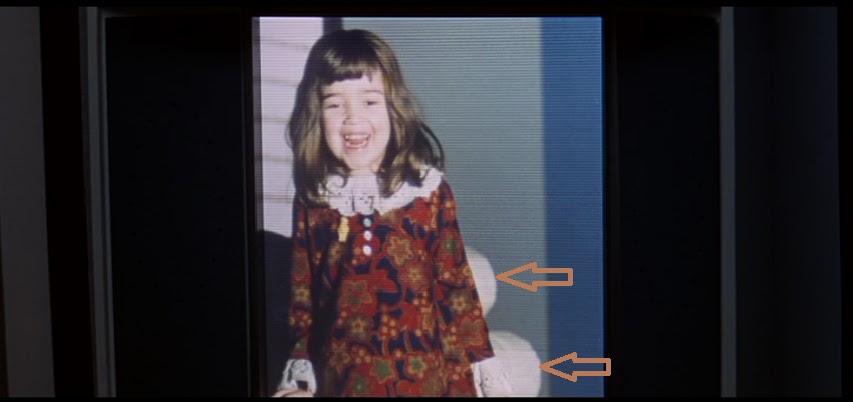
There are, in reality, no one's legs or feet near Floyd's daughter, as becomes obvious when she stands up near the end of the phone conversation (as shown at left), and her body's true orientation with respect to the surroundings of the room she's in becomes evident. The long gray objects (indicated by the two arrows in the screencap) are parts of a piece of furniture, not someone's legs. Nevertheless, Kubrick has here given us a hint as to something in his film that is 'hidden' from plain view: What's being suggested, by the image rotated ninety degrees clockwise as shown above, is that there could be an alien standing over the girl, in specific, an alien from the race that planted the monoliths, and it has effectively kidnapped her. Floyd's daughter wouldn't know she's been kidnapped, however, because the alien has fooled her by taking on human form (i.e., it normally appears to her to be a human; but see below). The reason we see the 'suggested alien' on the monitor appearing as it does to Floyd (i.e., like an alien instead of a human), is because we are here looking through Floyd's eyes, and Floyd himself is one of the aliens; or more accurately, an alien life force is 'occupying' his body.

Since our 'suggested alien' is standing right next to the daughter, it seems that she's lying about no one being around (she says that her mother isn't home, and that her caretaker, Rachel, is in the bathroom). What's ultimately being suggested, however, is not that the Floyd's daughter is lying, but instead, that the aliens can influence the minds of humans - they are able to get the girl to believe what they want her to believe, i.e., that no one is in the immediate area. This serves, in part, as a kind of security precaution, in case Floyd's phone conversation is overheard by someone else in the space station. If his daughter was to scream over the phone something like, "Help!! I've been kidnapped by aliens!", anyone who might overhear the conversation would no doubt get suspicious.


The fact that Floyd's body is occupied by an alien life force, explains his artificial, 'mechanical'-sounding manner of speaking, such as at the meeting at Clavius (shown at left): Even though the alien is able to occupy a human body, it's unable to fully mimic a human manner of speaking. However, Floyd is able to get through voice print identification security at the space station (as shown in the below left screencap), since the tone of his voice is the same as that of the 'original' Floyd (since Floyd's own vocal chords are being used to speak). Also, the alien is able to recognize people who Floyd knows, remember his home phone number, etc., because it has all of the knowledge and basic memory contents that the human Floyd had - the alien is effectively occupying not only Floyd's body, but his mind as well (and is therefore controlling his actions). Another hint we're given that Floyd's mind has been taken over by that of an alien, is that Floyd is shown having to read the instructions for the zero gravity toilet on the lunar lander (as shown at below right). Certainly the 'real' Floyd wouldn't need to read them, since, as suggested in his earlier conversation in the space station waiting area, with Elena, Dr. Smyslov, and the others, he has traveled in the lander before (i.e., he has made past trips from the space station to the moon). The point is that the alien must sometimes 'refresh' its memory about certain details - the retention of Floyd's memory by the alien isn't perfect.


Above left: Floyd has no trouble getting through voice print identification at the space station. Above right: Floyd needs to read the instructions for the zero gravity toilet on the lunar lander.


The rotating space station (shown at left) looks physically similar to a giant rotating film reel, and the rectangular slot in the hub in the middle could be imagined as being a key-hole: One 'key' to unlocking the meaning of the movie is image rotation, as described above.


Another rotation hint in 2001 is that the stargate transitions from a vertical orientation (above left) to a horizontal orientation (above right) while Bowman is moving through it, as if it has been rotated by ninety degrees.


Disclaimers
1) In certain instances it has been determined that the creators of some of the productions analyzed on this blog, and/or the creators of source material(s) used in the making of these productions, may be making negative statements about certain segments of society in their productions. These statements should be taken as expressing the opinions of no one other than the creators.

2) This blog is not associated with any of the studios, creators, authors, publishers, directors, actors, musicians, writers, editors, crew, staff, agents, or any other persons or entities involved at any stage in the making of any of the media productions or source materials that are analyzed, mentioned, or referenced herein.

3) In keeping with the policies of the filmmakers, authors, studios, writers, publishers, and musicians, that have created the productions (and their source materials) that are analyzed, mentioned, or referenced on this blog, any similarity of the characters in these films or source materials to actual persons, living or dead, is purely coincidental.

---------------------------------------------------------------------------------

All images on this blog are used solely for non-commercial purposes of analysis, review, and critique.

All Wikipedia content on this blog, and any edits made to it, are released under the Creative Commons Attribution-Share-Alike License 3.0.

Marcus Aurelius's Meditations - from Wikisource (except where otherwise noted); portions from Wikisource used on this blog are released under the Creative Commons Attribution-Share-Alike License 3.0.

Saint Augustine's Confessions and City of God from Wikisource (except where otherwise noted); portions from Wikisource used on this blog are released under the Creative Commons Attribution-Share-Alike License 3.0.

Saint Thomas Aquinas's Summa Theologica from the 'Logos Virtual Library' website (except where otherwise noted), compiled and edited by Darren L. Slider; believed to be in public domain.