Thursday, August 23, 2012

Taxi Driver analysis - part 4: The hidden plot; the film's ending portion is a dream

CATEGORY: MOVIES


In terms of Jungian psychology (i.e., analytic psychology: the psychological theory of Swiss psychologist and psychiatrist Carl Jung), Betsy (above left) and Iris (above right), taken together, represent Travis's anima: his feminine inner personality. Betsy represents that part of his anima that serves as the mediator between his unconscious and conscious mind, and Iris represents that part of his anima that's been 'cross-contaminated' with negative aspects of his psychological shadow. The shadow is an unconscious complex defined as the repressed, suppressed or disowned qualities of the conscious self.[a]


Taxi Driver's hidden plot

The basic hidden plot in the movie is that Betsy is a 'mole' in Senator Palantine's campaign, working for some individual or group that doesn't want him to become the President. Her task is to find someone who will assassinate the Senator, such that anyone who subsequently investigates the assassination won't be able to trace it to her or the people she's working for. Betsy sometimes walks through the 'sleazy' portion of the city (that is near the campaign office) alone, hoping an 'unstable' man (a man with a highly 'unresolved' anima, such as Travis) will approach her and ask her out. When she encounters Travis, she senses that she may have found her man. Then, she subtly 'burrows' her way into Travis's unconscious, and using her consequent power as the mediator between his unconscious and conscious mind, she informs him that he is a "walking contradiction". She effectively talks him into buying the Kristofferson album containing this lyric (The Silver Tongued Devil and I). Travis listens to the album, and effectively becomes the "I" of its title (this identification happens at an unconscious level). Having become motivated to 'work with the Devil', and after being disappointed by Palantine's reaction to his suggestion to 'clean up' New York City, he attempts to 'act out' the extreme right-wing end of his contradictory nature by going to the Senator's rally to try and assassinate him. When this fails, he later goes to Iris's building and shoots three men there (including Sport), thus helping to clean up New York.


Ultimately, Scorsese's movie is, in part, an 'allegory' for Arthur Bremer's assassination attempt on Democrat presidential hopeful George Wallace in Laurel, Maryland in 1972. The manipulation of Travis (representing Bremer) by Betsy in Taxi Driver, indicates that Scorsese believes Bremer himself was psychologically manipulated by a woman he met while she was working for the Wallace campaign, and that this manipulation started Bremer on the road to his attempt on Wallace's life. This woman was working as a 'mole' in Wallace's camp for some individual or group that didn't want Wallace to be elected. By the time Wallace was campaigning, his hard-line stance against racial integration had greatly softened; the party that wanted him dead feared that this and other factors indicated that if Wallace became president, he would restore the U.S. to a true democracy.

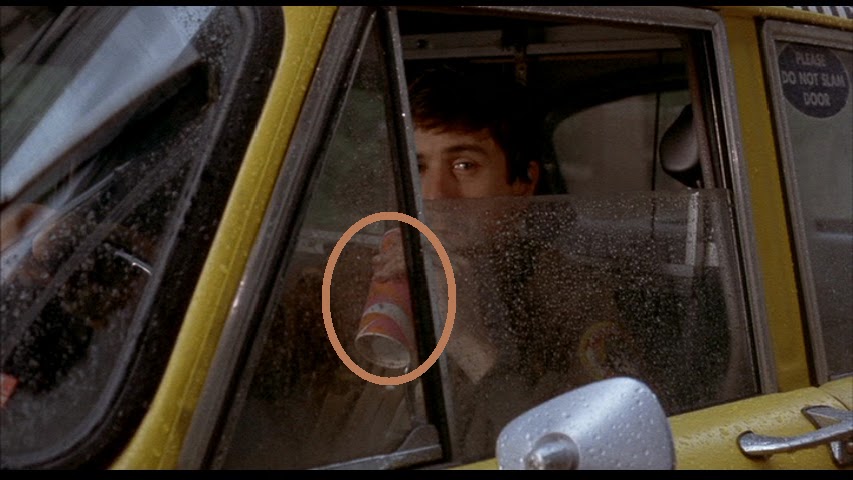


Betsy (above left), sitting in the campaign office, sees Travis (above right) staring at her from his cab on the street outside. Note the color design of the cup he is drinking from (click image to enlarge).


As can be seen at left, Betsy has cups of the same design as Travis's, sitting in her work area. These are drinks that Betsy bought while walking through the sleazy part of the city, trying to ensnare a man - she here sees and recognizes Travis's cup, and thus knows that he visits the seedy part of town, so she realizes he might be the unstable man she's looking for.


Above left: Later, when Travis enters the campaign office and starts conversing with Betsy, she can tell from the way he talks when he 'comes on' to her, that he views her as somewhat 'pure' and thus, that he tends to see things in black and white. She knows this is characteristic of some men who are uncomfortable around women due to having unresolved feelings about them as a group (essentially, a manifestation of the unresolved anima mentioned above). Ultimately, she senses that he may have the nascent mindset of the killer she is looking for. This is why she agrees to go out with him - she believes she may eventually be able to manipulate him into assassinating Palantine. In fact, it is during this conversation that Betsy subtly begins working her way into Travis's psyche, in part by responding to him in a manner that she senses he wants her to. Above right: During the conversation, Betsy pretends to demure. She doesn't want to appear 'easy to get'.

Later in the movie, Betsy rejects Travis after he takes her to see a 'porn' film. This was by design - Betsy knew where things were headed when Travis brought her to the front of the seedy theater, even before they entered it. Her planned complete and final rejection of him was designed to leave him feeling emasculated, thus setting him up to commit a 'manly' act - the killing of someone in a position of power.


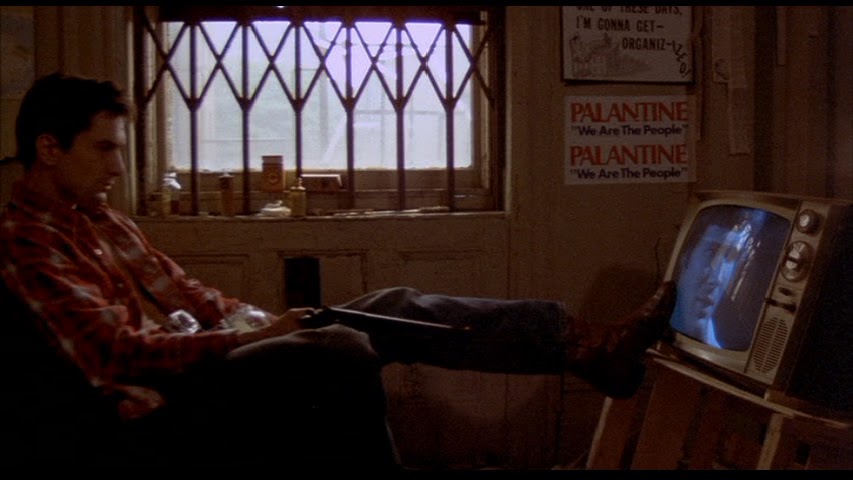
Top left: While conversing with Travis while being driven in his cab, Senator Palantine (in center in back seat) seems to empathize with Travis's stated desire to clean up New York City. Top right: However, after exiting the taxi and shaking hands with Travis, the Senator makes eye contact with a coworker as if to say, "that cab driver was a nut." Above left: Travis, who noticed this interaction, is disappointed that the Senator did not seriously consider his advice. Above right: A long-barreled gun Travis later purchases, here serves as a phallic symbol. According to plan, Travis thinks he has found a way to alleviate his feeling of emasculation.


The Senator was 'set up' by being directed to enter Travis's cab instead of taking his limousine (as per normal procedure). The man sitting to the Senator's left in the top left screencap above, is a corrupt Secret Service agent. During the ride, he says that the party should have waited for the limousine instead of taking a cab - the agent says this in anticipation of the chance that the other passenger in the cab (Palantine's coworker) would later (after the planned assassination) be questioned about why a cab was taken that night; the corrupt man would, by making this statement, avoid any suspicion being directed at himself. This man knew what Travis looked like (and thus knew which cab to put the Senator in) via someone (Betsy, or another mole) having described Travis's appearance to him, or even more likely, from viewing a photograph of Travis. It's probably the case that either someone took a photo of Travis unbeknownst to him, or else his taxi driver license, containing a photo of him, was obtained by the evil parties who want the senator dead, from the taxi company Travis works for. All of this is part of the Bremer/Wallace 'allegory' - which is not to be taken so literally as to indicate that, for example, the real-life mole's name was Betsy, or some such thing. Generally speaking, what we are supposed to realize is that some violent acts that are blamed (by police, the media, etc.) on 'lone-gunmen nuts', are ultimately committed by governmental or other powerful entities, without these acts being traceable to these entities. The individual gunmen themselves do not know that they are being manipulated, and instead believe that they are acting alone. It is crucial to understand what we have done here: We have connected supposed 'lone gunmam'/'lone nut' assassination (and other violent act) scenarios to so-called 'conspiracy theories' claiming that powerful parties are behind some of these acts. And, we have described in relative detail how it is that a certain kind of man, i.e., one with a highly unresolved anima (Travis), can be manipulated by evil parties.


Top left: At the first Palantine rally that Travis goes to, the tall man who questions him is a (non-corrupt) Secret Service agent, here taking down Travis's name and address under the pretext that he will have information sent to Travis about how to join the Service. (Travis gives him false information.) Top right: After the man is done talking to Travis, who has started to walk away, he motions to his fellow agent (who, unbeknownst to him, is corrupt; this is the same agent who was riding in Travis's taxi), to go after Travis and snap some pictures of him. Above left: The (corrupt) man, holding his camera, gets ready to pursue Travis. Above right: Initially, Travis, as he walks away, is facing away from the man with the camera.


Above left: While still walking away, Travis turns around a couple of times, exposing his face. His reason for doing so is that he wants his photo to be taken - he figures he will be identified as a hero after he assassinates the Senator, and he wants the public, via stories about him in the media, to know what he looked like. Travis knows the man has a camera because he saw him with it while Palantine was giving his speech. The man, since he has a camera, probably appears to the other people at the rally to be a member of the press. However, Travis recognizes him from the earlier cab ride. Above right: The agent with the camera, although he is positioned to snap a photo of Travis, intentionally delays long enough so that Travis gets lost in the crowd. The man exclaims, "Damn it!" while subsequently lowering his camera, so as to appear to his fellow agent (in case he's within hearing range), to not have been able to get any photos.

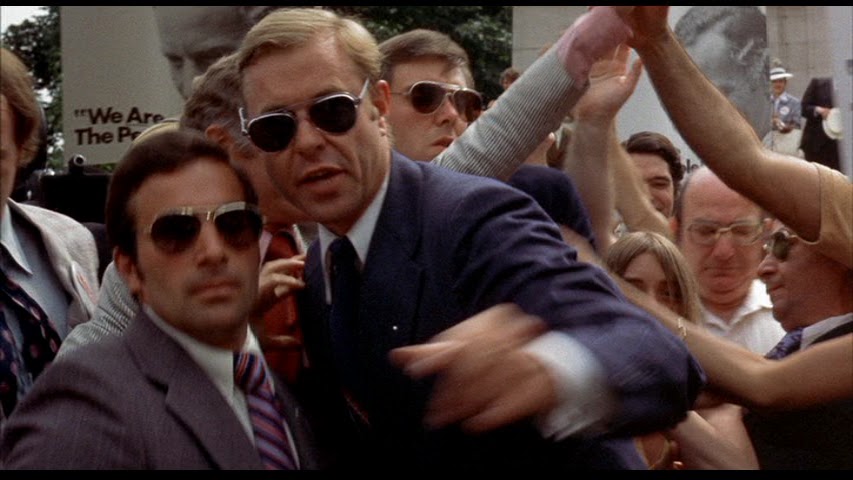


Above left: Later, at the second Palantine rally Travis attends, we see him about to draw his gun in preparation for shooting the Senator. Above right: The (non-corrupt) agent spots Travis and motions for the (corrupt) agent to go after him.


Above: The film's 'give-away' that the man sent to chase Travis is not acting in earnest, and is thus corrupt, is his body position upon colliding with the man in the orange shirt, while appearing to vigorously pursue Travis: A person who coincidentally collided with another individual while running quickly in pursuit of someone, would collide with their body in a mainly upright position, since this is the body's basic position while running. Instead, however, the agent bends forward at the waist and bends his knees just long enough prior to the collision, to avoid going down too hard on the pavement, indicating that he is really feigning an accidental collision. The point is that the agent didn't really want to 'catch' Travis, and he made things appear such that the collision prevented him from doing so.


The film's ending portion is a dream


Above left: After Travis has killed the men in Iris's rooming house, he attempts to commit suicide, but he's out of bullets. Above right: The fact that Travis knows he's about to die, is indicated by his feigned shooting of himself in front of the police while sitting on the couch.


While Travis is sitting on the couch bleeding from his neck, he fades out of consciousness and begins to experience a dream. Everything we see in the movie after this point in time, consists of the contents of this dream. The view of the dying Travis from above, suggests that he is here in a metaphorical Hell.


Above left and right: Travis's being depicted as a hero by the media (above left), giving a cab ride to Betsy (above right), etc., constitute the dream sequence he experiences just before he dies, from excessive bleeding due to the injuries he sustained during the shoot-out in Iris's building.


a. Wikipedia, 'Analytical psychology'. Web, n.d. URL = https://en.wikipedia.org/wiki/Analytical_psychology.


Friday, August 10, 2012

Taxi Driver analysis - part 3: The movie makes reference to biblical passages

CATEGORY: MOVIES


Top left and right: While Travis is driving a prostitute and her client (top left; click image to enlarge), we are briefly shown the cab fare meter reading '315' (top right). Above left: After dropping the pair off, Travis gives the cab a washing as he passes near an open fire hydrant, on his way back to the cab company's garage. Above right: At the garage, Travis is here shown having just cleaned off the rear seat of his cab with the rag he's holding. We hear his voice-over saying, "Each night when I return the cab to the garage I have to clean the come off the back seat. Some nights I clean off the blood."


The '315' in the top right screencap above refers to the bible's 3rd book, Leviticus, chapter 15, which falls under the heading Discharges Causing Uncleanliness. Verses 1-11 of this chapter read as follows [New International Version]:

1. The Lord said to Moses and Aaron, 2. "Speak to the Israelites and say to them: 'When any man has an unusual bodily discharge, such a discharge is unclean. 3. Whether it continues flowing from his body or is blocked, it will make him unclean. This is how his discharge will bring about uncleanness: 4. Any bed the man with a discharge lies on will be unclean, and anything he sits on will be unclean. 5. Anyone who touches his bed must wash their clothes and bathe with water, and they will be unclean till evening. 6. Whoever sits on anything that the man with a discharge sat on must wash their clothes and bathe with water, and they will be unclean till evening. 7. Whoever touches the man who has a discharge must wash their clothes and bathe with water, and they will be unclean till evening. 8. If the man with the discharge spits on anyone who is clean, they must wash their clothes and bathe with water, and they will be unclean till evening. 9. Everything the man sits on when riding will be unclean, 10. and whoever touches any of the things that were under him will be unclean till evening; whoever picks up those things must wash their clothes and bathe with water, and they will be unclean till evening. 11. Anyone the man with a discharge touches without rinsing his hands with water must wash their clothes and bathe with water, and they will be unclean till evening.' "


Some of the men who ride in the back of Travis's cab have sex with prostitutes, and thus may have contracted one or more sexually transmitted diseases, some of which can cause unusual discharges from the body. (For example, gonorrhea can cause a white, yellow, or green discharge from the penis.[a]) Then, in accordance with the above verses, the rear cab seat becomes 'unclean' when a man with such a disease sits on it, and thus, Travis himself may become unclean in the process of cleaning off the seat later, for example, if he sits on the seat while reaching with his rag to clean part of it. Travis would also become unclean if he touches such a man while collecting the fare from him, or in other scenarios in which he might touch the man, or the man might touch him. In strict accordance with the Leviticus verses, if one or more of the foregoing occurs, Travis must wash his clothes and bathe with water, and he will be unclean "till evening."


a. National Institutes of Health Medline Plus Gonorrhea page.


Tuesday, August 7, 2012

Taxi Driver analysis - part 2: References to Kubrick's '2001: A Space Odyssey'

CATEGORY: MOVIES

Taxi Driver makes at least a couple of visual references to Stanley Kubrick's 1968 film, 2001: A Space Odyssey. Scorsese's reason for inserting these references, is so that we will deduce that there are also correspondences in themes between the two movies as well.


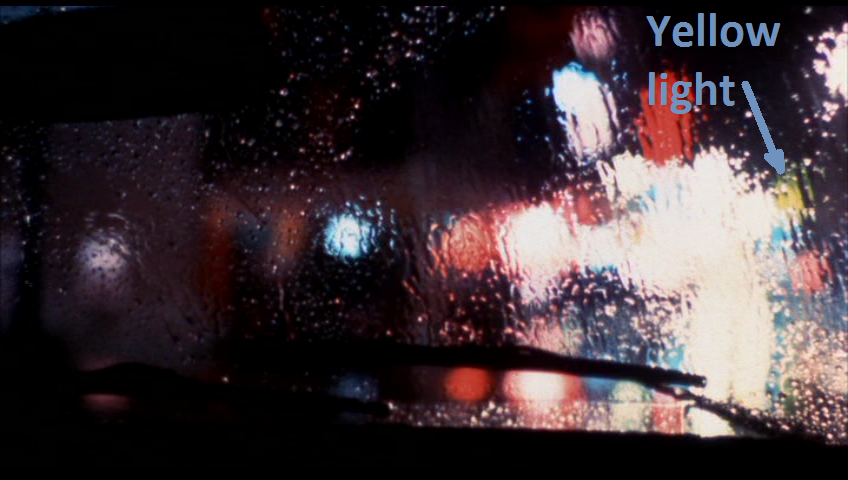
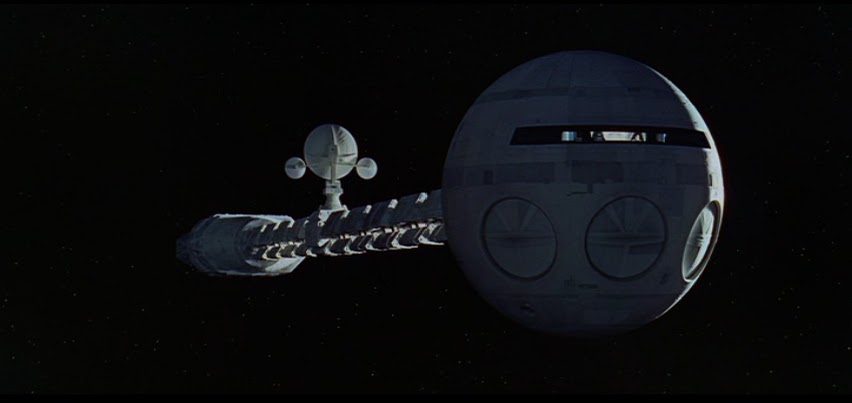
Top left and right: The colors in Travis's view through the windshield of his taxi (top left), while he's driving on the street at night, are similar to the colors that A Space Odyssey astronaut David Bowman sees at one point, as he moves through the stargate in Kubrick's film (top right). In comparing the colors Travis sees through his cab's windshield, to the colors in the 2001 stargate at the moment shown, we note that the dominant theme of both is one of red-white-blue, with there also being a relatively small amount of yellow in both the stargate and the cab windshield views (the yellow in the latter can be seen at the far right-center of the top left screencap). The red-white-blue from Taxi Driver not only implies that Scorsese is making a reference to America (the colors of the American flag are red, white, and blue), but it's also a hint from Scorsese that the fact that these same colors appear at the point in the stargate shown, means that Kubrick himself is saying something in A Space Odyssey, that has to do with America. Above left and right: The building Iris operates out of (above left) is a reference to the rectangular Space Odyssey monolith (above right).

According to Douglas Trumbull, Special Photographic Effects Supervisor for A Space Odyssey, "[E]ach showing [of A Space Odyssey] draws an increasing number of [hippies], who would probably prefer to just see the last two reels over and over again."[a] These hippies were no doubt particularly interested in viewing the 'psychedelic' stargate sequence, so that they would, as Trumbull put it, "get the trip of their lives."[a] We note that Travis corresponds to these particular viewers, in the sense that he constantly (and thus effectively, 'repeatedly') looks out of his windshield while driving his cab, suggesting the idea of him repeatedly viewing the image in the top left screencap above which, as stated, corresponds to the view of the stargate shown in the screencap to its right. Then, in accordance with this, taking Travis as the metaphorical 2001 movie-goer viewing the stargate, not only does he here represent the hippies, but the fact that he's in a yellow cab is the connection between the yellow in the stargate, and the hippies themselves: In 2001, Kubrick is saying something about the hippies, that has to do with the yellow in the stargate. Noting that most of this yellow in the stargate, at the point shown, is in the form of streaks, and that the term 'yellow streak' is sometimes used to indicate cowardice, Kubrick (and Scorsese, in making his reference to Kubrick) are saying that the historical hippies are/were the 'cowards of America'.


Travis's taxi is yellow. According to the Dictionary of Symbols, "Yellow is the vehicle of youth, strength, and divine immortality...Catholic priests [lead] the dead towards eternal life against a backdrop of yellow and gold...The discovery of yellow in the guise of eternal life in the chthonian world, brings us to the second symbolic aspect of the colour...It also heralds decrepitude, old age, and the approach of death...The traditions of the Peking Theatre bear equal witness to the reversal of the properties of yellow, its actors painting their faces in that colour as a mark of cruelty, deceit, and cynicism, while painting their faces red to show honest and decent characters...This ambivalence recurs in Greek mythology. The golden apples from the Garden of the Hesperides were a symbol of love and concord...However, the Apple of Discord, which was a cause of the Trojan War, was also a golden apple and the symbol of pride and jealousy."[b]


The fact that yellow has contradictory symbolic aspects, indicates that Travis himself is a man of contradictions. This is why he can be a politically-right-leaning man (he wants to 'clean up' New York City), and at the same time, represent a left-leaning hippie (at least, in the context discussed above). Later in the analysis, we will see that there is a 'hidden plot' in the movie, involving Betsy wanting to 'bring out' an 'extremist' element of Travis's two-fold nature.


The stargate sequence in 2001: A Space Odyssey consists, in part, of a series of 'psychedelic' images that David Bowman sees (as he travels rapidly through space), such as the one shown above and the two shown immediately below.


Top left: This image in the stargate is suggestive of green 'slime'. Top right: As described in the Space Odyssey analysis on this blog, the red coloring 'flowing' under the diamond-shaped objects in this shot from the stargate sequence, represents the Styx, a river in the 5th circle of Dante's Inferno (Hell). Above left: The slimy substance on the driver's side of Travis's windshield is a recently thrown egg; it is intentionally made to appear green by Scorsese using lighting effects. Above right: The green and red lights in some of the views through Travis's windshield, such as the ones shown here, symbolically indicate that his movement through the boroughs of New York City at night, represents his movement along the 'stygian sewer' that flows through the city's 'slimy underworld'.


a. Trumbull, Douglas. "Creating Special Effects for "2001: A Space Odyssey"." American Cinematographer. Web, n.d. URL = http://www.visual-memory.co.uk/sk/2001a/page3.html.
b. Dictionary of Symbols, Ed. Jean Chevalier and Alain Gheerbrant. Trans. John Buchanan-Brown. London: Penguin Group, 1996. pp. 1137, 1138, 1139.


Monday, August 6, 2012

2001: A Space Odyssey analysis - part 1: Introduction and plot synopsis

CATEGORY: MOVIES; WARNING: THIS ANALYSIS CONTAINS SPOILERS!!


[Image at left from the Wikipedia '2001: A Space Odyssey (film)' page; "2001 A Space Odyssey (1968) theatrical poster variant",[a] licensed under fair use via Wikipedia.]


Welcome to the analysis of 2001: A Space Odyssey. Buttons at the bottom of each post enable navigation through the parts of the analysis. You may want to view the table of contents. Regarding the appearance of possible anti-Semitism on this blog, please see the 'Disclaimers' section near the bottom of this page. The contents of the analysis of 2001 on this blog are identical, to those of the analysis of the movie on the Can Analyze Kubrick blog, except that there are a few additional posts in this analysis that are not contained in the other one, most of which have to do with hints for interpreting A Space Odyssey, from some of the films of Quentin Tarantino.


An introduction and plot synopsis for the movie appear below.[b]

2001: A Space Odyssey is a 1968 epic science fiction film produced and directed by Stanley Kubrick, and co-written by Kubrick and Arthur C. Clarke. The story deals with a series of encounters between humans and mysterious black monoliths that are apparently affecting human destiny, and a space voyage to Jupiter tracing a signal emitted by one such monolith found on the moon. Keir Dullea and Gary Lockwood star as the two astronauts on this voyage, with Douglas Rain as the voice of the sentient computer HAL, who seems human and has almost full control over their spaceship.


The film consists of four major sections, all of which, except the second, are introduced by superimposed titles.


The Dawn of Man
A tribe of herbivorous early humans is foraging for food in the desert. A big cat kills one member, and another tribe of man-apes drives them from their water hole. Defeated, they sleep overnight in a small exposed rock crater, and awake to find that a black monolith has appeared in front of them. They approach it shrieking and jumping, and eventually touch it cautiously. Soon after, one of the man-apes (played by Daniel Richter) realizes how to use a bone as a weapon; the members of the tribe later use bones to kill prey for food. Still later, they reclaim control of the water hole from the other tribe by killing its leader. Triumphant, the tribe's leader throws his bone into the air as the scene shifts (via match cut) from the falling bone to an orbital weapons satellite millions of years in the future.[c]


Above left: A tribe of our ape-like early ancestors, encounters the monolith for the first time. Top right: The leader of the tribe of ape-men discovers how to use a bone as a weapon. Above left and right: The match cut from bone to orbiting weapons satellite.


TMA-1
A Pan Am space plane carries Dr. Heywood R. Floyd (played by William Sylvester) to a space station orbiting Earth for a layover on his trip to Clavius Base, a U.S. outpost on the moon.


The Pan Am space plane carrying Heywood Floyd.


After making a videophone call from the station to his daughter (Vivian Kubrick), Floyd encounters his friend Elena (Margaret Tyzack), a Russian scientist, and her colleague Dr. Smyslov (Leonard Rossiter), who asks Floyd about odd things occurring at Clavius, and the rumor of a mysterious epidemic at the base. The American firmly declines to answer any questions about the supposed epidemic.


Dr. Smyslov (seated at left) questions Heywood Floyd (center) about the supposed epidemic at Clavius base. Elena is seated at right.


Floyd then travels from the space station, to Clavius base on the moon.

At Clavius, Floyd heads a meeting of base personnel, apologizing for the epidemic cover story but stressing the need for secrecy. His mission is to investigate a recently found artifact — "Tycho Magnetic Anomaly One" (TMA-1) — according to Floyd, deliberately buried four million years ago. Floyd and some other men ride in a moonbus to the artifact, a black monolith identical to the one encountered by the apes. The men (six total individuals, including Floyd) examine the monolith, and pose for a photo in front of it. While doing so, they hear a very loud high-pitched noise, presumably coming from the monolith.


The six astronauts descend into the excavation at TMA-1, where a monolith has been sighted.


Jupiter Mission
Eighteen months later, the American spaceship Discovery One is bound for Jupiter. On board are mission pilots and scientists Dr. David Bowman (Keir Dullea) and Dr. Frank Poole (Gary Lockwood), and three other scientists who are in cryogenic hibernation. "HAL" (voiced by Douglas Rain) is the ship's HAL 9000 computer, which runs most of Discovery One's operations. While Bowman and Poole watch HAL and themselves being interviewed in a BBC show about the mission, the computer states that he is "foolproof and incapable of error." HAL also speaks of his enthusiasm for the mission, and how he enjoys working with humans. When asked by the host if HAL has genuine emotions, Bowman replies that he appears to, but that the truth is unknown.


Above left: The Discovery One spaceship as viewed from the front right side. Above right: Discovery One from the rear right.


Top left: Discovery One astronaut David Bowman converses with mission computer HAL. Top right: HAL's camera 'eye'. Above left: Bowman's fellow astronaut, Frank Poole, watches a BBC broadcast about his and Bowman's mission to Jupiter. Above right: Two of the three astronauts who are in hibernation.


HAL asks Bowman about the unusual mystery and secrecy surrounding the mission, but interrupts himself to report the imminent failure of a device which controls the ship's communications antenna. After retrieving the component with an EVA pod, the astronauts cannot find anything wrong with it. HAL suggests reinstalling the (supposedly) defective unit and letting it fail so the problem can be found.


Above left: Bowman (wearing a red spacesuit) has exited his EVA pod, and is here shown approaching Discovery One's communications antenna. Above right: Bowman removes the (supposedly) defective device from the antenna assembly. As will be described later in the analysis, it is evident that this device, known as an AE-35 unit, controls the positioning of the communications antenna. Note the replacement unit sitting to Bowman's right - we are never shown the replacement unit being installed; this fact will come into play later in the analysis.

Mission control concurs with HAL's suggestion (to reinstall the (supposedly) defective unit), but advises the astronauts that results from their twin HAL 9000 indicate the ship's HAL is in error predicting the fault. When queried, HAL insists that the problem, like all previous issues with the HAL series, is due to "human error." Concerned about HAL's behavior, Bowman and Poole enter one of the EVA pods to talk without the computer overhearing them. They both have a bad feeling about HAL, despite the HAL series' perfect reliability, but decide to follow his suggestion to replace the unit. As the astronauts agree to deactivate the computer if it is proven to be wrong, they are unaware that HAL is reading their lips through the pod's window.


Top left: Poole and Bowman converse inside an EVA pod (which is located in the pod bay aboard Discovery One), about their doubts regarding HAL. Note the window in the pod. Top right: HAL, whose camera 'eye' is visible in the distance, can see through the pod window. HAL cannot hear the two men talking, however, since the pod door is shut and the pod itself is sealed, and the men have deactivated all the electronic devices which might enable HAL to hear them. Above left and right: A view from HAL's perspective, of Poole's and Bowman's lips moving, as visible through the window just mentioned. As becomes evident later in the movie, HAL knows the contents of the two men's conversation from reading their lips.


After Poole exits Discovery One to reinstall the (supposedly) defective AE-35, Poole's EVA pod (below left screencap), controlled by HAL, moves toward Poole and then hits him, severing his oxygen hose and setting him adrift in space (below right).


Bowman, not realizing the computer is responsible for Poole's being set adrift, takes another pod to attempt a rescue, leaving his helmet behind. While he is gone, HAL terminates the life functions of the three crew members in suspended animation (below left). When Bowman returns to the ship with Poole's body, HAL refuses to let him in, stating that he cannot allow the mission to be jeopardized. Bowman manually opens the ship's emergency airlock and bodily enters the ship (below right), risking death from lack of oxygen.


After donning a helmet, Bowman proceeds to HAL 9000's memory core intent on disconnecting the computer. HAL first tries to reassure Dave, then pleads with him to stop, and finally begins to express fear. Dave ignores him and disconnects each of the computer's memory modules. HAL eventually regresses to his earliest programmed memory, the song "Daisy Bell", which he sings for Bowman.

When the computer is finally disconnected, a pre-recorded video message from Floyd plays. In it, he reveals the existence of the four million-year-old black monolith on the moon. Floyd says that it has remained completely inert, except for a single, very powerful radio emission aimed at Jupiter, and then adds that the monolith's origin and purpose is "still a total mystery."

Jupiter and Beyond the Infinite

Near Jupiter, Bowman leaves Discovery One in an EVA pod and finds another monolith in orbit around the planet (as shown at left). Approaching this monolith, Bowman's pod is suddenly pulled into a tunnel of colored light, and a disoriented and terrified Bowman finds himself racing at great speed across vast distances of space, viewing bizarre cosmological phenomena and strange landscapes of unusual colors. He finds himself, older and still in his spacesuit, standing in a room appointed in the Louis XVI-style. Bowman sees progressively older versions of himself, his point of view switching each time, alternately appearing sitting at a table eating, and finally as a very elderly man lying in a bed. A black monolith appears at the foot of the bed, and as Bowman gestures toward it with his right arm and hand, he is transformed into a fetus-like being enclosed in a transparent orb of light. The new being floats in space beside the Earth, gazing at it.


Top left: Bowman sees this image while moving through space (i.e., through the 'stargate') at a high rate of speed. Top right: An aged Bowman sitting at a dining table, in a Louis XVI-style room. Above left: Bowman gestures toward the monolith from his bed. Above right: The fetus in an orb of light, floating near Earth.


One thing we will be doing in this analysis, is looking at hints given to us to help unlock the meaning of Kubrick's movie, in the films of other movie-makers, such as those of Quentin Tarantino, Michael Mann, David Lynch, and the creators of the Hannibal Lecter films.


a. Poster for 2001: A Space Odyssey: The poster art copyright is believed to belong to the distributor of the film, Metro-Goldwyn-Mayer (Turner Entertainment), the publisher of the film or the graphic artist. Further details: 2001: A SPACE ODYSSEY © 1968 Turner Entertainment Co. An epic drama of adventure and exploration (film poster).
b. Wikipedia, '2001: A Space Odyssey (film)'. Web, n.d. URL = https://en.wikipedia.org/wiki/2001:_A_Space_Odyssey_(film).
c. The orbiting object is a nuclear weapons satellite: The Making of Kubrick's 2001. Ed. Jerome Agel. Signet, 1970. p. 196 and caption in photographs section.


Disclaimers
1) In certain instances it has been determined that the creators of some of the productions analyzed on this blog, and/or the creators of source material(s) used in the making of these productions, may be making negative statements about certain segments of society in their productions. These statements should be taken as expressing the opinions of no one other than the creators.

2) This blog is not associated with any of the studios, creators, authors, publishers, directors, actors, musicians, writers, editors, crew, staff, agents, or any other persons or entities involved at any stage in the making of any of the media productions or source materials that are analyzed, mentioned, or referenced herein.

3) In keeping with the policies of the filmmakers, authors, studios, writers, publishers, and musicians, that have created the productions (and their source materials) that are analyzed, mentioned, or referenced on this blog, any similarity of the characters in these films or source materials to actual persons, living or dead, is purely coincidental.

---------------------------------------------------------------------------------

All images on this blog are used solely for non-commercial purposes of analysis, review, and critique.

All Wikipedia content on this blog, and any edits made to it, are released under the Creative Commons Attribution-Share-Alike License 3.0.

Marcus Aurelius's Meditations - from Wikisource (except where otherwise noted); portions from Wikisource used on this blog are released under the Creative Commons Attribution-Share-Alike License 3.0.

Saint Augustine's Confessions and City of God from Wikisource (except where otherwise noted); portions from Wikisource used on this blog are released under the Creative Commons Attribution-Share-Alike License 3.0.

Saint Thomas Aquinas's Summa Theologica from the 'Logos Virtual Library' website (except where otherwise noted), compiled and edited by Darren L. Slider; believed to be in public domain.