On this site will be posted analyses of popular media productions. These analyses will have to do with determining the underlying meanings of various movies, songs, and certain novels. Methods used to analyze a given production will include exploration of the creators' use of symbolism, allegory, metaphor, etc., and deciphering any arcane or obscure references that it may contain.
In this post we continue with Lynch's 6th clue to interpreting the movie: Notice the robe, the ashtray, the coffee cup.
We went over the significance of the 'piano' ashtray in part 15 of the analysis. Shown in the above left screencap is a different ashtray, the one near Diane's phone. Earlier in the analysis, we discussed the fact that the cigarettes in this ashtray appear to be the same kind the hit man smokes. Their presence indicates that he and Diane had already discussed the hit to be done on Camilla prior to their meeting in Winkie's. It has also been discussed how the man with the yellow phone (the hairy-armed man, above right screencap) appeared to be calling the phone near the ashtray, from inside the same building as that in which this phone (the one near the ashtray) is located. What must be the case is that the phone and ashtray shown here are in a room in a 'sleazy' hotel or rooming house, out of which Diane plies her trade as a call-girl. Normally, when the hairy-armed man calls it is to let her know to meet with a given client who is requesting her services; but in this instance, he's calling to let her know to go to the audition Adam is staging. When Diane later dreams of Adam being in a sleazy hotel room, the room he's in is Diane's dream-representation of her own room as shown here. As mentioned earlier, Diane's dream of bad things happening to Adam is a form of dream-revenge for his not giving her the role she desired, and for what appears to Diane to be his romantic involvement with Camilla, which causes Diane to be jealous, since she's in love with Adam.
We went over the significance of Diane's pink and white robes in part 15. In the screencap at left, Rita is shown wearing a robe that is somewhat more 'regal'-looking than Betty's simple pink robe. The idea here is that the part of Diane that Betty represents (her persona), sees Rita as a 'movie queen' of sorts. Since this is what Diane herself desires to be, and since Rita represents Diane's subconscious (in addition to representing Camilla), the fact that Rita's wearing this robe here not only signifies Diane's desire to be a famous actress, but it also tells us something about the esteem in which Diane holds Camilla, insofar as status as an actress - she sees Camilla as being 'above' herself in this regard. In short, Diane sees Camilla as the actress she herself desires to be.
Above left: This man, a client of Diane (as a call girl), happens to see and recognize her at the Mulholland Drive party. This gives Diane a sickening feeling, especially since he's staring at her. Above right: Notice the foam floating on top of Diane's coffee.
Having seen the client at the party, along with the sickening feeling and the sight of the foam, combine in Diane's dream to yield the 'espresso man', Luigi Castigliane, who becomes nauseous and spits out his drink at the business meeting with Adam and the others.
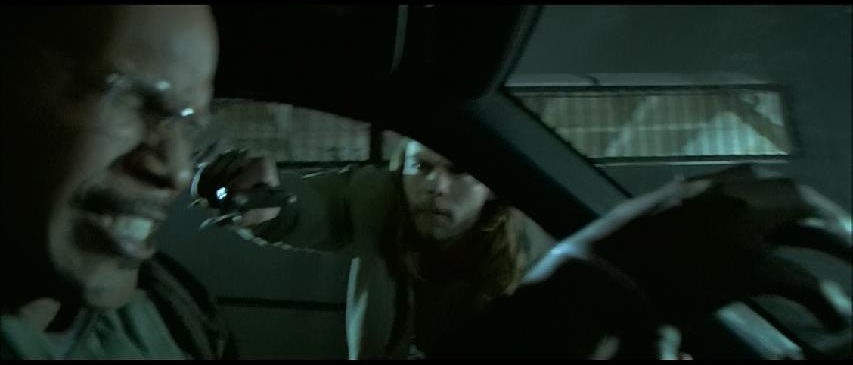
In part 6 of the analysis we observed that the first stage of alchemy's Great Work, the nigredo ("the blackening"), is characterized by chaos. It is also associated with the encounter with one's psychological shadow, melancholia, and putrefaction and decomposition. The scenario in Mann's Collateral is that cab driver Max Durocher experiences four nigredos. The first occurs when hit man Vincent's first victim, Ramone Ayala, falls out of a window down several stories and lands, dead, on the top of Max's cab. This is a chaotic scene, and thus represents a nigredo. Max's second nigredo occurs while Vincent is performing his hit on Sylvester Clarke. While Vincent is in Clarke's condo, Max is sitting outside in his cab waiting, with his hands tied (by Vincent) to the steering wheel. When Max shouts for help, two young hoodlums respond, and one of them steals Vincent's briefcase from the back seat. When Vincent shows up, he shoots the two men dead. There is chaos during the entire sequence of events. Max suffers a panic attack after Vincent's third hit, jazz club owner Daniel Baker, is shot point blank in the head. This scene, too, is chaotic. Finally, there is complete chaos and pandemonium in the nightclub, Club Fever, before, during, and after the execution of gangster Peter Lim.
From Collateral - Max's four nigredos: Top left: Ramone Alaya falls onto the top of Max's taxi after being shot by Vincent. Top right: Max is harangued by some armed hoodlums, who end up being shot by Vincent. Above left: Vincent shoots jazz club owner Daniel Baker, immediately after which Max has a panic attack. Above right: Pandemonium in Club Fever.
Since Max defeats Vincent before Vincent can kill Annie Farrell, his intended fifth and final hit, there are four nigredos being depicted in the movie corresponding to Vincent's four hits.
From Thief: It's evident from the surface action in the film that Leo, Frank's 'boss' (left) provides Frank (right) and his partner, Jessie, with a baby boy, but as discussed in the separate analysis of Thief on this blog, a component of the 'hidden' plot is that Leo has also provided Frank with Jessie herself; or more correctly, he has provided Jessie with Frank, so that she and the child will have a means of support.
From Heat: Neil, Chris's 'boss', confronts Charlene about her cheating on her husband (Chris). Neil demands that she give Chris one more chance to make a big score and then not blow the money by gambling it away. (Chris lost most of his 'earnings' from the previous robbery due to debts from a visit to Las Vegas.) This conversation 'points to' the hidden plot in Thief, in that there must have been one or more 'behind-the-scenes' conversations between Leo and Jessie; these two characters are never shown in one another's presence, nor are they heard speaking with each other (such as over the phone), at any point during the movie (Thief). Thus, their conversations constitute action in the film that is 'hidden' from Thief's audience. This audience must deduce the fact that these conversations took place, based on the surface action in the film.
In this post, we begin to explore clue number 6 of "David Lynch's 10 clues to unlocking this thriller": Notice the robe, the ashtray, the coffee cup. (Note that we are skipping over clue number 5 - the last clue considered was number 4).
Above left: Diane and the hit man in Winkie's. Notice the brown coffee cup. Above right: Diane at home. Note that the coffee cup is the same kind that's used in Winkie's. This is an indication that Diane, at some point, worked in Winkie's. (This doesn't preclude the possibility that she worked at Pink's, as stated earlier in the analysis. Winkie's would have been a 'step up' for her).
Above left: Diane as 'Betty', wearing a nice pink bathrobe while rehearsing with Rita. Above right: Diane is wearing a worn white robe when her former roommate, L.J. DeRosa, drops by. The idea here is that the scene with the nice robe depicts a dream, while the scenes in which Diane is wearing the white robe depict reality.
Above left: Diane's former roommate retrieves the 'piano' ashtray. Above right: Shortly after this, Diane experiences a masturbatory fantasy in which she and Camilla are together on the couch. However, the fact that the piano ashtray is present indicates that we have reverted to a former moment in time, so this scene actually depicts a 'fantasy-flashback'.
The chain of events involving the former roommate are as follows: When Diane first moved into the Sierra Bonita apartments, she moved into number 12. While living there she befriended a woman named L.J. DeRosa who lived in number 17. At some point Diane moved into number 17 to live with DeRosa, so that both women could save some money on rent. Diane slept on the couch, and DeRosa slept in the bedroom. Then at some point while the two women were living together, Diane made one or more sexual advances toward DeRosa and was rejected, and this created an uncomfortable situation, so it was determined that one of them had to move out. Since Diane had already placed the hit on Camilla, and since she knew her therapist had overheard her doing so while in Winkie's, she knew people would be looking for her, so she convinced DeRosa to move into number 12, and DeRosa did so. When in Diane's dream, Betty and Rita found 'D. Selwyn' in the phone book, she was listed as living at number 12, her old address. (Entries in phone books are generally updated only once per year). It's DeRosa's voice that answers the phone when Betty and Rita call Diane's number. When DeRosa comes back to number 17 to retrieve some items she left there, she awakens Diane, and a brief encounter ensues. When DeRosa says "it's been three weeks", what she means is that it's been three weeks since she moved out of number 17.
Betty and Rita sink down in the back seat of the taxi they're in (above left), to avoid being seen by the two plainclothes detectives sitting in the green car parked near the brick wall (above right), while entering the Sierra Bonita apartment complex. This is Diane's dream representation of herself eluding two detectives who have been looking for her for placing the hit on Camilla.
The two plainclothes police detectives who have been sitting in the car outside Sierra Bonita, initially came calling for Diane at no. 12, and found DeRosa there. DeRosa later told Diane that the police had come looking for her. The detectives then began to 'stake out' the area by waiting on the street near the complex. When they didn't see Diane coming or going, they went to see DeRosa a second time. It was at her visit to Diane to retrieve the rest of her belongings, that DeRosa informed Diane that the two detectives had come looking for her again. She must have told the detectives during one of their visits to her, that Diane was living in apartment 17. The detectives then came by number 17 on that fateful evening that Diane was sitting in her apartment staring at the blue key. When they began to knock on the door, Diane hallucinated, seeing the couple that raised her, then she killed herself.
What all this does not imply, is that Camilla is simply a representation of DeRosa. Camilla is a (real) woman whom Diane placed a hit on, but Diane only fantasized that she had had lesbian encounters with Camilla. The real 'love story' of the movie is the one between Diane and Adam, although as stated earlier, this love is purely one-sided, on Diane's part; i.e., she loves Adam 'from afar'.
Diane (above left) is upset by Adam and Camilla getting close (above right) at the Mulholland Drive party. This is because she is in love with Adam, and is jealous of Camilla.
There is no actual lesbian relationship or lesbian sex being depicted in the movie. The sex between Betty and Rita takes place in a dream, and Diane's sexual encounter with Camilla is a fantasy, as noted above. And, Diane only hoped to have sex with DeRosa.
The event that triggered Diane's lesbian fantasies, was her seeing a blond woman kiss Camilla at the Mulholland Drive party. What we see here is Diane's interpretation of the kiss, whereas in all likelihood it was, in reality, just a peck on the cheek from a friend.
The same screencap as that shown in part 12 of the analysis, showing the hit man, prostitute, and pimp exiting Pink's.
A magnified view of a portion of the above screencap. Note the yellow lettering of the Yellowstone sign on the awning above the store, and a set of decorative green, red, and blue rectangles at the far right-hand side of the store exterior. One purpose of the coloring of the lettering and the rectangles, taken together, is to let us know that yellowing, and thus the alchemical citrinitas stage (and therefore the chemical wedding, between male and female),[a] is being elevated above the other three colors/stages in importance (the awning lettering is higher up than the rectangles). Closer examination of the colors reveals additional symbolism: The colors of the reddish and blueish rectangles are actually magenta and cyan, respectively; therefore, taking the yellow lettering together with the colors of the three rectangles, we have the additivesecondary colors (yellow, magenta, and cyan), with the green (of the top rectangle) being the odd one out. It is, in fact, the importance of green that Lynch is stressing in this scene (in addition to yellow), as described below.
As Carl Jung says,
"The unconscious is always the fly in the ointment, the skeleton in the cupboard of perfection, the painful lie given to all idealistic pronouncements, the earthliness that clings to our human nature and sadly clouds the crystal clarity we long for. In the alchemical view rust, like verdigris, is the metal's sickness. But at the same time this leprosy is the vera prima materia, the basis for the preparation of the philosophical gold. The Rosarium says:
Our gold is not the common gold. But thou hast inquired concerning the greenness [viriditas, presumably verdigris], deeming the bronze to be a leprous body on account of the greenness it hath upon it. Therefore I say unto thee that whatever is perfect in the bronze is that greenness only, because that greenness is straightway changed by our magistery into our most true gold.[b]
The paradoxical remark of Thales that the rust alone gives the coin its true value is a kind of alchemical quip,[c] which at bottom only says that there is no light without shadow and no psychic wholeness without imperfection. To round itself out, life calls not for perfection but for completeness; and for this the "thorn in the flesh" is needed, the suffering of defects without which there is no progress and no ascent."[d]
a. That Jung regards the chemical (i.e., chymical) wedding as a union between man and woman, is evident from his Psychology and Alchemy: "Here the supreme opposites, male and female (as in the Chinese yang and yin), are melted into a unity purified of all opposition and therefore incorruptible." (--Jung, C.G., The Collected Works of C.G. Jung, Vol. 12, Princeton University Press, 1968, para. 43.)
b. Basileae, Artis Auriferae, Vol. II, p. 220: a quotation from Senior, in Jung, C.G., The Collected Works, Vol. 12, para. 207.
c. "That is indeed what men most seek on earth: 'Tis rust alone that gives the coin its worth!"
d. Jung, C.G., The Collected Works, Vol. 12, paras. 207-208.
Recall Lynch's ten clues to interpreting the movie (listed in part 2 of the analysis) - we've already looked at clues nos. 1 and 2. Continuing with #3: Can you hear the title of the film that Adam Kesher is auditioning actresses for? Is it mentioned again?
In Diane's dream, when Adam Kesher (above left) is shown auditioning actresses (such as the Camilla Rhodes 'double' shown at above right), we hear him at one point announce, "Sylvia North Story, Camilla Rhodes take one." The point is that in this part of Diane's dream, Adam is auditioning actresses for his film, The Sylvia North Story.
The Sylvia North Story is mentioned again later in Mulholland Drive (but earlier chronologically) than the above scene, at the Mulholland Drive party, when Diane tells some guests at the party that she once auditioned for a movie of this name, but that Camilla got the role. In this scene, which takes place in reality, it is stated that Bob Brooker was the director of the movie.
The version of The Sylvia North Story to be directed by Adam, is actually Diane's dream-fantasized remake of the one directed by Brooker - it is to be a remake of Diane's own life story (where 'Sylvia (from the) North' = 'Selwyn from Canada'). In reality, some director whom Adam represents and with whom Diane is in love, is to make some movie that Diane hopes to be in, and Diane fears that Camilla will get the role in this movie, so she places the hit on Camilla.
Clue #4: An accident is a terrible event - notice the location of the accident.
Rita walks off into the woods after the accident on Mulholland Drive.
This clue is designed to get us to realize that the accident occurred on the same road (Mulholland), as that on which Diane was being driven to the party at Adam's place. Then, as indicated in part 12, the 'dream-trauma' of the accident represents the trauma Diane experienced at the party, with both events representing an alchemical nigredo for Diane.
From Thief: Frank's montage-like photograph depicts people, places, and events from his past, present, and (desired) future life, all together pictorially as if they all exist 'here and now'. Frank desires to retire and settle down with a family, but he also desires to escape ordinary space-time (speaking metaphorically, of course); this can be accomplished, so he believes, by moving his newly-acquired family to Calfornia, which the movie suggests is, in some sense, outside the bounds of ordinary space and time (the specific idea of Calfornia existing outside the bounds of ordinary space/time, is covered in part 8 of the separate analysis of Thief on this blog).
From Heat: Vincent's view while driving. The song playing in this scene is called Always Forever Now, a title which is reminiscent of what was said about Frank's montage above.
From Heat: Vincent (far right) is located in California and is somewhat settled, with his own family of sorts, so in a sense he represents the achievement of Frank's goal. However, he soon 'discovers' that he can't hold a family together while devoting himself to chasing down criminals. This is the tension Mann is depicting, an internal tension that each of us lives with at some level or another: We want to be free of restraints, and yet at the same time we want stability in our lives; and within the context of these two competing desires, in no scenario are we ever wholly satisfied.
The hit man (far left), along with a prostitute and her pimp, are shown exiting the Pink's hot dog establishment. Note the red, green, and blue colored rectangles in the windows across the street (upper right area of photo); also note the nearby yellow 'Yellowstone' sign lettering (click on image to enlarge). Jung's four primary colors are red, green, blue, and yellow. In this scene, one thing we're supposed to realize is that yellow is being 'elevated' in importance above the other three colors, since the Yellowstone sign is higher up than the three window rectangles. Another thing to notice in this scene, however, are the red items: the red fire department vehicle and the red pole, at far right. The point of having these objects here is to associate redness with what's going on in this scene.
A few moments later in the same scene, a red trash can comes into view (lower right of photo). Also note the red 'Aaron Brothers' sign across the street at upper left. Only the portion of the Yellowstone sign that says 'Yellow' or 'Yellows' is now visible (just above center in screencap - click to enlarge).
The prostitute prepares to climb into the back of the blue van. Recall that earlier in the analysis, we said that the hit man's blue key opens the back door of this van (or at least, it did until the van was broken into or hit in an accident, as evidenced by the damage on the door; now the key is no longer needed, since the lock has been broken). The overall idea here is that we're supposed to associate redness with prostitution, and the blue van with Diane's alchemical rubedo, as described below.
Recall from our discussion of Diane's alchemical stages in part 11, that we said the fourth and final stage, the rubedo, represents the Self archetype. As we said, the Self manifests itself in "wholeness," a point in which a person discovers his or her true nature. What's being done in the scene shown in the above screencaps, is that the final stage of the alchemical process, the rubedo ('the reddening'), is being associated with the final stage of Diane's individuation, her Self, via the blue symbolism - the blue box represents the blue van, and the magical blue key represents the van door key. Near the end of Diane's dream-sequence, which comprises almost the entire first two hours of the movie, the blue box is opened and the Self is revealed: Diane's true nature is that she is a prostitute. It is at the point of this realization that the box hits the floor, and Diane awakens to reality.
Diane's experience at the Mulholland Drive party (specifically, her state of melancholia), represents her alchemical nigredo stage.
Later (chronologically speaking), the experience at the party is represented in Diane's dream by the chaotic accident on Mulholland. In other words, the accident is the dream-representation of Diane's nigredo.
Lately we have been discussing Diane's process of individuation. Swiss psychologist and psychiatrist Carl Jung associated the stages of individuation with the processes of alchemy. In the below, we'll go over the basics of alchemy, and we'll begin to look at Diane's dream-representations of alchemical stages.
Alchemy is an ancient tradition, the primary objective of which was the creation of the mythical "philosopher's stone," which was said to be capable of turning base metals into gold or silver, and also act as an elixir of life that would confer youth and immortality upon its user. The philosopher's stone is created by the alchemical method known as The Magnum Opus or The Great Work. Often expressed as a series of color changes or chemical processes, the instructions for creating the philosopher's stone are varied.[a] The Great Work originally had four stages:
1) nigredo, a blackening or melanosis 2) albedo, a whitening or leucosis 3) citrinitas, a yellowing or xanthosis 4) rubedo, a reddening, purpling, or iosis
After the 15th century, many writers tended to compress citrinitas into rubedo and consider only three stages. However, it is in citrinitas that the chemical wedding takes place, generating the Philosophical Mercury without which the philosopher's stone, triumph of the Work, could never be accomplished.[b]
In the framework of psychological development (especially for followers of Jungian psychology) these four alchemical steps are to be taken as analogous to the process of attaining individuation.[c] Let us examine the four steps in greater detail.
1. Nigredo, or blackness, in alchemy means putrefaction or decomposition. The alchemists believed that as a first step in the pathway to the philosopher's stone all alchemical ingredients had to be cleansed and cooked extensively to a uniform black matter. In psychology, Carl Jung (a student of alchemy) interpreted nigredo as a moment of maximum despair, that is a prerequisite to personal development. The nigredo is associated with melancholia, chaos, and the encounter with the psychological shadow.[d]
There are at least two depictions of putrefaction and decomposition in the movie: The partially decomposed body of the woman that Betty and Rita, and in another scene the Cowboy, see lying in bed, above left; and the person behind Winkie's (whom as we've said, represents Diane's shadow), above right.
The accident on Mulholland is obviously a chaotic event.
2. Albedo - following the harrowing, chaotic nigredo, it is necessary for purification provided by the albedo which is literally referred to as ablutio; the washing away of impurities by aqua vitae. Jung equated the albedo with unconscious contrasexual soul images; the anima in men and animus in women. It is a phase where insight into shadow projections are realized, and inflated ego and unneeded conceptualizations are removed from the psyche.[e]
After Rita experiences the chaos of the accident, she is found in the shower at Betty's Havenhurst apartment (as shown at left). The shower represents her albedo/ablutio, i.e., the (attempted) washing away of impurities.
3. Citrinitas literally referred to "transmutation of silver into gold" or "yellowing of the lunar consciousness", and in alchemical philosophy stood for the dawning of the "solar light" inherent in one's being, and that the reflective "lunar or soul light" was no longer necessary. In Jungian terms, citrinitas is the Wise Old Man (or Woman) archetype.[f]
As we've seen, Louise Bonner represents the Wise Old Woman archetype in Diane's dream. Later in the analysis, we'll look at what yellow/yellowing has to do with Diane's citrinitas.
Louise Bonner represents Diane's Wise Old Woman archetype.
4. Rubedo is a Latin word meaning "redness." In an archetypal schema, rubedo would represent the Self archetype, and would be the culmination of the four stages. The Self manifests itself in "wholeness," a point in which a person discovers his or her true nature.[g]
Diane's dream-rubedo occurs at the moment that Rita is 'sucked into' the blue box (which then falls on the floor - see screencap at left), i.e., it takes place just before Diane awakens. Later on we'll look at Diane's rubedo in more detail, including what redness has to do with it. We should observe here, however, that the reason the movie seems like a Möbius stripto many viewers, is because a nigredo is presented to us as taking place both at the beginning of the movie, during the chaotic accident, and near the end of the film, during the chaos in Diane's apartment when she 'sees' the couple who raised her haranguing her, and then shoots herself. It's as if Diane's alchemical process 're-begins' at the end of the movie (by virtue of the fact that the ending represents a nigredo). Within this context, the film acts on each viewer's subconscious (i.e., unconscious) mind.
a. Wikipedia, 'Philosopher's stone'. Web, n.d. URL = https://en.wikipedia.org/wiki/Philosopher%27s_stone.
b. Wikipedia, 'Magnum opus (alchemy)'. Web, n.d. URL = https://en.wikipedia.org/wiki/Magnum_opus_(alchemy).
c. Ibid.
d. Wikipedia, 'Nigredo'. Web, n.d. URL = https://en.wikipedia.org/wiki/Nigredo.
e. Wikipedia, 'Albedo (alchemy)'. Web, n.d. URL = https://en.wikipedia.org/wiki/Albedo_(alchemy).
f. Wikipedia, 'Citrinitas'. Web, n.d. URL = https://en.wikipedia.org/wiki/Citrinitas.
g. Wikipedia, 'Rubedo'. Web, n.d. URL = https://en.wikipedia.org/wiki/Rubedo.
As implied in the previous part of this analysis, the blue box is symbolic of Diane's Self, which is the final stage of the process of individuation. According to Jungian psychology, individuation is a process of psychological integration, having for its goal the development of the individual personality. "In general, it is the process by which individual beings are formed and differentiated; in particular, it is the development of the psychological individual as a being distinct from the general, collective psychology. Individuation, therefore, is a process of differentiation, having for its goal the development of the individual personality."[a]
Individuation is a process of transformation whereby the personal and collective unconscious is brought into consciousness (by means of dreams, active imagination or free association to take some examples) to be assimilated into the whole personality. It is a completely natural process necessary for the integration of the psyche to take place. Individuation has a holistic healing effect on the person, both mentally and physically.[b] -------------------------------------------------------------------------
The cheerful Betty Elms represents Diane Selwyn's 'dream-persona'.
Diane's persona is represented in her dream by Betty. (When it was suggested in part 10 that Betty represents Diane's ego, this meant within the context of her being absent when Rita opens the blue box - this symbolizes the ego submitting to the Self.) Louise Bonner represents the Wise Old Woman, and the person behind Winkie's represents Diane's shadow. Actually, the person behind Winkie's appears as a man to Dan, but he/she represents a woman for Diane - the shadow is generally same-sex.
a. Jung, C.G. The Collected Works of C.G. Jung, Vol. 6. Princeton University Press, 1971. para. 757.
b. Wikipedia, 'Individuation'. Web, n.d. URL = https://en.wikipedia.org/wiki/Individuation.
Disclaimers 1) In certain instances it has been determined that the creators of some of the productions analyzed on this blog, and/or the creators of source material(s) used in the making of these productions, may be making negative statements about certain segments of society in their productions. These statements should be taken as expressing the opinions of no one other than the creators.
2) This blog is not associated with any of the studios, creators, authors, publishers, directors, actors, musicians, writers, editors, crew, staff, agents, or any other persons or entities involved at any stage in the making of any of the media productions or source materials that are analyzed, mentioned, or referenced herein.
3) In keeping with the policies of the filmmakers, authors, studios, writers, publishers, and musicians, that have created the productions (and their source materials) that are analyzed, mentioned, or referenced on this blog, any similarity of the characters in these films or source materials to actual persons, living or dead, is purely coincidental.
Saint Augustine's Confessions andCity of God from Wikisource (except where otherwise noted); portions from Wikisource used on this blog are released under the Creative Commons Attribution-Share-Alike License 3.0.
Saint Thomas Aquinas's Summa Theologica from the 'Logos Virtual Library' website (except where otherwise noted), compiled and edited by Darren L. Slider; believed to be in public domain.