Thursday, August 25, 2011

Manhunter - Analysis of the Movie - part 1: Introduction; Will's similarity to the killer

CATEGORY: MOVIES; WARNING: THIS ANALYSIS CONTAINS SPOILERS!!    [Hidden plot related]

[Image at left from the Wikipedia 'Manhunter (film)' page; "Manhunter michael mann film poster",[a] licensed under fair use via Wikipedia.]


Welcome to the analysis of Manhunter. Buttons at the bottom of each post enable navigation through the parts of the analysis. Posts in this analysis having to do with the hidden plot, such as this post, are marked with the words "[Hidden plot related]" under the post title; if you are only viewing the hidden plot explanation, you may skip over the other parts. You may want to view the table of contents.


Manhunter is a 1986 thriller film based on Thomas Harris's novel Red Dragon. Written and directed by Michael Mann, it features Brian Cox as the popular character Hannibal Lecter (although the character's name is spelled "Lecktor" in this film) and stars William Petersen, Joan Allen, Kim Greist, Dennis Farina and Tom Noonan.

Petersen plays Will Graham, a former FBI profiler who captured the infamous Dr. Hannibal Lecktor and was almost killed in the process; he is so traumatized by the event that he retires from the FBI. His former boss, Jack Crawford, calls him out of retirement to help find a killer called "The Tooth Fairy" who is murdering entire families. Crawford wants Graham on the case because Will has an uncanny ability to empathize with a killer. [b]
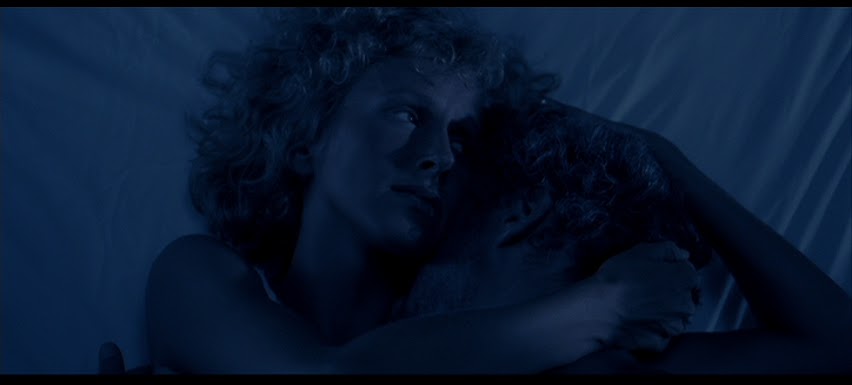


Above left: There is suggestion right from the beginning of the movie that Will is in some ways like the killer, the Tooth Fairy (Francis Dollarhyde). In an early scene in which Will and his wife, Molly, are in bed together, Will licks her neck several times (click image to enlarge). This is suggestive of what we later discover to be Dollarhyde's propensity for biting his female victims. Above right: A hard visual clue we are given of a likeness between Will and Dollarhyde is given in two scenes (taken together) which take place early in the movie: we notice that Graham follows the same path and sees the exact same physical objects on the steps leading to the Leeds family's bedrooms (as shown here), as did Dollarhyde when climbing these same steps in the scene before the movie title display. Since the Leeds family was one of Dollarhyde's victim families, the physical explanation for the two men's views being identical is that the crime scene has been preserved; but nevertheless, the fact that we, the Manhunter audience, are shown the two essentially identical scenes (Dollarhyde climbing the Leeds' stairs, and later, Graham climbing them), is to get across the idea that Graham is like the killer, in one or more respects.


a. Poster for Manhunter: The poster art copyright is believed to belong to the distributor of the film, De Laurentiis Entertainment Group, the publisher of the film or the graphic artist.
b. Wikipedia, 'Manhunter (film)'. Web, n.d. URL = https://en.wikipedia.org/wiki/Manhunter_(film).


Monday, August 22, 2011

2001 analysis - part 5: Hints from Tarantino's 'Pulp Fiction'

CATEGORY: MOVIES


Above left: Dr. Heywood Floyd 'celebrates' his daughter's birthday by video telephone communication with her, from the space station, on his way to the moon. Above right: Floyd's little girl as she appears to him while he's conversing with her. Left: The opening 'diner scene' from Pulp Fiction. 'Pumpkin' (aka 'Ringo'), seated on the right, and 'Honey Bunny' (aka Yolanda) are getting ready to rob the diner at gunpoint. During their pre-robbery discussion, Ringo describes to Yolanda a bank robbery scenario he previously heard about. This part of their conversation appears below.


Ringo: I heard about this one bloke, he walks into a federal bank with a portable phone, he gives the phone to the teller, the bloke on the other end of the phone says, 'We got this guy's little girl. If you don't give him all your money, we're gonna kill 'er'.

Yolanda: Did it work?

Ringo: Fuckin' A it worked, that's what I'm talkin' about. Knucklehead walks into a bank with a telephone, not a pistol, not a shotgun, but a fuckin' phone, cleans the place out, and they don't even lift a fuckin' finger.

Yolanda: Did they hurt the little girl?

Ringo: I don't know. There probably never was a little girl in the first place. W-well the point of the story isn't the little girl. The point of the story is, they robbed the bank with a telephone!!
---------------------------------------------

The little girl mentioned in the Pulp Fiction diner conversation is a reference to Heywood Floyd's daughter, and the idea of robbing a bank with a telephone is a hint that A Space Odyssey's Heywood Floyd is involved in some kind of 'robbery'.


Friday, August 19, 2011

2001 analysis - part 4: A correspondence with Quentin Tarantino's 'Reservoir Dogs'

CATEGORY: MOVIES


The six astronauts prepare to descend into the excavation at the TMA-1 site on the moon. They all look essentially identical with their spacesuits on.


The six men in dressed in identical black and white suits are the main characters from Quentin Tarantino's Reservoir Dogs. Shown here in the slow-motion opening scene they are, from left to right, Mr. Blonde, Mr. Brown, Mr. White, Mr. Orange, Mr. Pink, and Mr. Blue. They are meant to correspond, in some sense, to the six astronauts from 2001 shown above. [Image from the Wikipedia 'Reservoir Dogs' page,[a] licensed under fair use via Wikipedia.]


a. Screenshot from film copyright 1992 Miramax Films.


Friday, May 13, 2011

Lecter series - unified analysis - part 1: Lecter's magic touch

CATEGORY: MOVIES; WARNING: THIS ANALYSIS CONTAINS SPOILERS!!

Welcome to the unified analysis of the first three Hannibal Lecter movies: Manhunter, The Silence of the Lambs, and Hannibal. Buttons at the bottom of each post enable navigation through the parts of the analysis. You may want to view the table of contents. This unified analysis is not a compilation or summary of the individual analyses of the three movies just mentioned; rather, it is an extension of those analyses. Regarding the appearance of possible anti-Semitism on this blog, please see the 'Disclaimers' section near the bottom of this page.

We begin by observing that in two of the three movies analyzed in this unified analysis, The Silence of the Lambs and Hannibal, Hannibal Lecter represents, among other entities (including a personification of Satan), the evil elite hermaphroditic Jews who, along with other evil parties (e.g., certain high-ranking Freemasons and Mormons), desire to establish a modern-day 'New Jerusalem' (i.e., a utopia) in southern Indiana. However, in Manhunter, the character's surname is spelled 'Lecktor', and this spelling change indicates that Hannibal does not represent Jews, or any subset thereof, in Manhunter. There will be more on the details of the name change itself later.


From The Silence of the Lambs: Using his right hand, Lecter touches Starling's hand through the cell bars in Memphis. Not long after this, Starling has her revelation about Jame Gumb assembling his 'suit' of skin from various pieces of his women victims' skins.


From Hannibal: Lecter uses his right hand to touch Starling's hair, as he passes her on the carousel in Union Station. The purpose of this 'magic touch' is to help protect Starling when she later encounters Mason Verger and his goons at Verger's boar pen.


Sunday, March 13, 2011

Thief - Analysis of the Movie - part 1: Introduction and plot synopsis

CATEGORY: MOVIES; WARNING: THIS ANALYSIS CONTAINS SPOILERS!!

[Image at left from the Wikipedia 'Thief (film)' page; "Thief 1981",[a] licensed under fair use via Wikipedia.]


Welcome to the analysis of the movie Thief. Buttons at the bottom of each post enable navigation through parts of the analysis. We begin with a basic description and plot synopsis of the movie:[b]

Thief is a 1981 neo-noir crime film written and directed by Michael Mann and based on the novel The Home Invaders by "Frank Hohimer" (the pen name of real-life jewel thief John Seybold). The film's cast includes James Caan, Tuesday Weld, James Belushi, Robert Prosky and Willie Nelson.


Plot Synopsis
Frank is an expert jewel thief and hard-boiled ex-convict with a set structure to his life. With a pair of successful Chicago businesses (a bar and a car dealership) as fronts for his very lucrative criminal enterprise, Frank sets out to fulfill the missing part of his dream: a family beginning with Jessie, a cashier he has begun seeing.

After taking down a major score, Frank's fence is murdered. He finds out that the man responsible is a Mr. Attaglia, a shady plating company executive for whom the fence was working. Attaglia is in possession of money that belongs to Frank, who demands it back. This leads to a face-to-face meeting with Attaglia's employer, Leo, a high-level fence and Chicago Outfit boss, who wants Frank to work for him, offering him "boxcar" profits.


Above left: Frank, an expert jewel thief. Above right: Leo, a high-level fence and Chicago Outfit boss.


Frank is reluctant at first, but wanting to make his dream come to fruition faster, he agrees to do just one job. Soon he is taking part in a large-scale West Coast diamond heist. With a little help from the paternal Leo, he is even able to purchase a baby on the black market, a son he names after his closest friend from prison, Okla (whose real name is David).

It all seems too good to be true. Frank's big payday finally comes, only for Leo to renege. An irate Frank demands his money in 24 hours or there will be consequences.

Frank drives to his car lot to meet with his friend and associate Barry, unaware that Leo's henchmen are waiting for him. Frank is knocked unconscious and Barry is shot to death. Frank awakens with Leo staring down at him, surrounded by his henchmen. Leo coldly informs Frank that he, Jessie, their child, and everything Frank owns are Leo's property.


Above left: Jessie, Frank's love interest. Above right: Barry, Frank's associate.


Leo even threatens to prostitute Jessie and kill Frank's family if Frank does not continue in his work for him. Leo tells Frank to "tighten up" and focus on his responsibilities; meanwhile, his henchmen eliminate Barry's body.

Frank goes home and orders Jessie out, saying their marriage is over. He has an associate drive her and the baby somewhere where they cannot be found.

With nothing to lose, Frank blows up their house. He proceeds to drive around doing the same to his business establishments. He then breaks into Leo's house, beating up Attaglia and shooting Leo to death. As Frank walks outside, he is confronted by Attaglia and another of Leo's men. A gunfight ensues. The final scene is of a wounded Frank walking away into the night.


a. Poster for Thief: The poster art copyright is believed to belong to the distributor of the film, United Artists, or the publisher or creator of the film.
b. Wikipedia, 'Thief (film)'. Web, n.d. URL = http://en.wikipedia.org/wiki/Thief_(film).


Saturday, March 12, 2011

Lecter series - unified analysis - part 54: Wrapping up the analysis

CATEGORY: MOVIES


Recall the discussion of Jungian psychological types in part 39 of this analysis. Top left: A scene from the beginning of The Silence of the Lambs: At the movie's beginning, Clarice Starling's psychological type is introverted feeling; as discussed in part 39, she is later 'converted' to an introverted intuitive type. Throughout the movie, she is an introvert. Top right: Hannibal Lecter is an extraverted thinking type. Above left: Ardelia Mapp displays this 'extraverted' congratulatory gesture toward Starling at the FBI graduation ceremony. Some of the key people involved in the undermining of Starling (e.g., Lecter, and Ardelia) are depicted as being more extraverted than Clarice. The Silence of the Lambs is thus, in part, an 'allegory' for how our extraverted Western society tends to work against introverts. Above right: Starling takes command of the drug bust operation in Hannibal, the sequel to The Silence of the Lambs. The 'corruption' of Clarice's soul coincides with her becoming more extraverted.

(As stated in the previous post in this analysis, the fact that Ardelia is giving Clarice a congratulatory gesture at the ceremony, does not mean that she has been working on Clarice's side; she is here simply going out of her way to pretend that she has been on Clarice's side all along).

By the end of The Silence of the Lambs, Starling has become Lecter's Jungian opposite (in terms of psychological types). Also, as described earlier in this analysis, Clarice has assimilated Gumb, her 'moral opposite', with this symbolizing the Catholic Church's assimilation of evil.


Thief analysis - part 12: Representation of Abraham and Sarah

CATEGORY: MOVIES


Jessie (played by Tuesday Weld) acquires a baby.


In part 7 of the analysis we observed that some of the characters in the movie are metaphorically depicted as residing in Limbo, the first circle of Dante's Inferno (Hell). In Canto IV (i.e., chapter 4) of the Inferno, Dante's guide through Hell, Virgil, mentions to him various figures from the bible's Old Testament, including Abraham, and states that they were confined to this circle until the death of Christ.[a]

Frank represents the biblical figure Abraham, and his partner, Jessie, represents Abraham's wife, Sarah, who could not have children due to the fact that she was sterile; this corresponds to Jessie not being able to have children. Frank and Jessie's 'adopted' child, whom they named David, was provided by Leo; this corresponds to God 'providing' a child, Isaac, for Abraham and Sarah (this is not to say that Leo himself represents the Christian God as such).


a. Wikipedia, 'Inferno (Dante)'. Web, n.d. URL = http://en.wikipedia.org/wiki/Inferno_(Dante).


Friday, March 11, 2011

2001 analysis - part 3: Bowman's experience of enlightenment-death-rebirth

CATEGORY: MOVIES


Above left: David Bowman experiences enlightenment on his death-bed, as signified by the fact that he's pointing at the monolith - he has come to know the monolith's true meaning (the meaning of the monolith will be discussed later in the analysis). Above right: Just after this, Bowman dies and is then reborn. This whole sequence of events neatly encapsulates one of the movie's underlying themes, that of enlightenment-death-rebirth.


Saturday, March 5, 2011

Thief analysis - part 11: The hidden plot

CATEGORY: MOVIES


Jessie waits for Frank at the hospital, so the two of them can see Okla. She arrived before Frank because Okla knew how to have her contacted, i.e., he already knew her prior to being 'introduced' to her by Frank in the hospital.


Recall that Jessie arrived at the hospital before Frank when they went to visit Okla (see the screen capture above); this implies that Okla knew how to have Jessie contacted. What's going on is that Okla already knew Jessie, prior to the hospital visit; in fact, Okla is involved in a scenario whereby Jessie, who cannot have a child naturally, can first obtain a male partner, Frank, and then acquire a child, all via Leo. What Leo is to get out of the deal is the 'use' of Frank, in order to make money from Frank's thefts. Jessie knows she needs a male partner, i.e., a prospective father, to look better to an adoption agency. However, since she also knows Frank is a former convict, she actually knows ahead of time that they will not qualify to adopt - that's why she suggests to Frank that they leave the agency they visit, right after Frank tells the worker there that he was in prison. She must go through the motions of going to the agency in order for things to appear normal to Frank, but in reality she knows she will ultimately have to get a baby illegally through Leo. As indicated above, from Leo's perspective, Frank is a necessary part of the whole arrangement, so that Leo will get something in return for providing Jessie with a child.


Jessie wouldn't have waited for two hours for Frank to show up at his nightclub to meet with her, if she wasn't Hell-bent on acquiring a child - note the exasperated look on her face (as shown at left) while she waits for him.


Recall that Leo at one point says to Frank that he provided him with a family - he's referring to both Jessie and the baby, not just the baby. Finally, recall that it was Jessie who suggested naming the child after Okla (whose real name was David) - this is further evidence of a pre-existing relationship between her and Okla.


Thief analysis - part 10: Okla is Frank's guardian angel

CATEGORY: MOVIES


Frank pays Okla a visit.


Recall that Frank had gotten himself into serious trouble while in prison, and, as he tells the story to Jessie, we can safely conclude that he was kept from being killed during an incident that occurred while he was incarcerated (the 'Captain Morphis' incident), by some sort of miracle. The actual miracle occurred not at the point when Frank was facing Morphis, but instead later, when Frank walked out into the open prison yard thinking he was going to be killed by the other inmates, as a result of the incident. The reason this miracle came about was because Okla was acting as a guardian angel for Frank. A guardian angel is an angel assigned to protect and guide a particular person. In addition to protecting Frank, Okla acted as his guide, in that he taught Frank everything he knows about safe-cracking (recall that Frank tells Jessie this during the diner conversation).


Disclaimers
1) In certain instances it has been determined that the creators of some of the productions analyzed on this blog, and/or the creators of source material(s) used in the making of these productions, may be making negative statements about certain segments of society in their productions. These statements should be taken as expressing the opinions of no one other than the creators.

2) This blog is not associated with any of the studios, creators, authors, publishers, directors, actors, musicians, writers, editors, crew, staff, agents, or any other persons or entities involved at any stage in the making of any of the media productions or source materials that are analyzed, mentioned, or referenced herein.

3) In keeping with the policies of the filmmakers, authors, studios, writers, publishers, and musicians, that have created the productions (and their source materials) that are analyzed, mentioned, or referenced on this blog, any similarity of the characters in these films or source materials to actual persons, living or dead, is purely coincidental.

---------------------------------------------------------------------------------

All images on this blog are used solely for non-commercial purposes of analysis, review, and critique.

All Wikipedia content on this blog, and any edits made to it, are released under the Creative Commons Attribution-Share-Alike License 3.0.

Marcus Aurelius's Meditations - from Wikisource (except where otherwise noted); portions from Wikisource used on this blog are released under the Creative Commons Attribution-Share-Alike License 3.0.

Saint Augustine's Confessions and City of God from Wikisource (except where otherwise noted); portions from Wikisource used on this blog are released under the Creative Commons Attribution-Share-Alike License 3.0.

Saint Thomas Aquinas's Summa Theologica from the 'Logos Virtual Library' website (except where otherwise noted), compiled and edited by Darren L. Slider; believed to be in public domain.